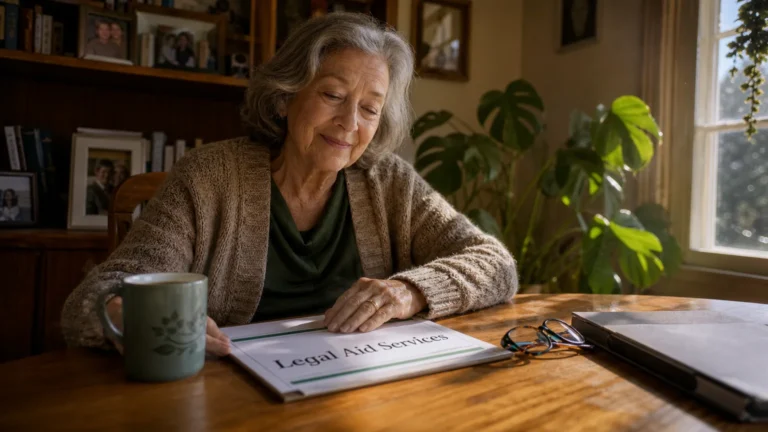

Legal problems can threaten your housing, savings, and health care, yet private lawyers often charge hundreds of dollars an hour. Fortunately, you can access free legal help for seniors through federal, state, and nonprofit programs nationwide.
Some programs depend on your household income, while others have no financial limits at all if you meet the age requirement. You just need to know which agencies handle your issue and how to contact them.
This guide walks you through the main programs, eligibility rules, and practical steps to connect with an attorney without draining your retirement.

In This Briefing05 Sections ▾
Key Concepts and Terminology Explained
Before calling a hotline, it helps to know how free legal services for seniors work. Programs use specific terms to define who they serve and what cases they take.
Most programs handle civil legal aid—non-criminal disputes like evictions, unpaid bills, benefit denials, and consumer fraud. Criminal charges work differently because courts appoint public defenders when someone faces jail time.
Many older adults seek help with elder law, a specialty covering Medicare, Medicaid, long-term care, guardianship defense, and financial abuse. It also includes estate planning documents like wills, powers of attorney, and advance health care directives.
Two other terms matter when you apply:
- Means testing is a financial review where an agency checks your income or savings before accepting your case.
- Pro bono representation refers to legal work private lawyers donate free of charge.
Legal problems affect millions of older Americans—nearly 8 million seniors live below 125% of the poverty threshold, and 46% of low-income Americans who skip legal help cite cost concerns.
According to the Legal Services Corporation 2022 Justice Gap Report, 74% of low-income households faced a civil legal problem, yet 92% of substantial needs lacked adequate help. Private elder law attorneys charge $195 to $500 per hour, making free aid vital.
A Practical Guide to Getting Free Legal Help
You have four main pathways to find free legal aid for older adults nationwide. Matching your situation to the right program saves time and speeds up your case.
1. Older Americans Act Legal Assistance
If you are 60 and older, start with Title III-B of the Older Americans Act. Under federal Administration for Community Living rules, providers must offer legal help with no income or asset test.
Means testing is illegal here, so staff cannot force you to disclose savings or home value. Programs may invite voluntary contributions—encouraged at 185% of poverty or higher—but never deny service if you cannot pay.
Roughly 1,000 federally funded providers deliver nearly 1 million hours of help annually. They prioritize housing, utilities, health care, long-term care, income, guardianship defense, abuse, neglect, and age discrimination, though they rarely take fee-generating cases.
Call the Eldercare Locator at 1-800-677-1116 (voice or text), Monday through Friday from 8:00 a.m. to 9:00 p.m. Eastern Time. Administered by USAging, it connects you to 618 Area Agencies on Aging.
The Eldercare Locator handles roughly 400,000 requests each year, routing you directly to local aging specialists. Have your county and a brief summary of your issue ready so staff can transfer you to the right intake line.
2. Legal Services Corporation Civil Legal Aid
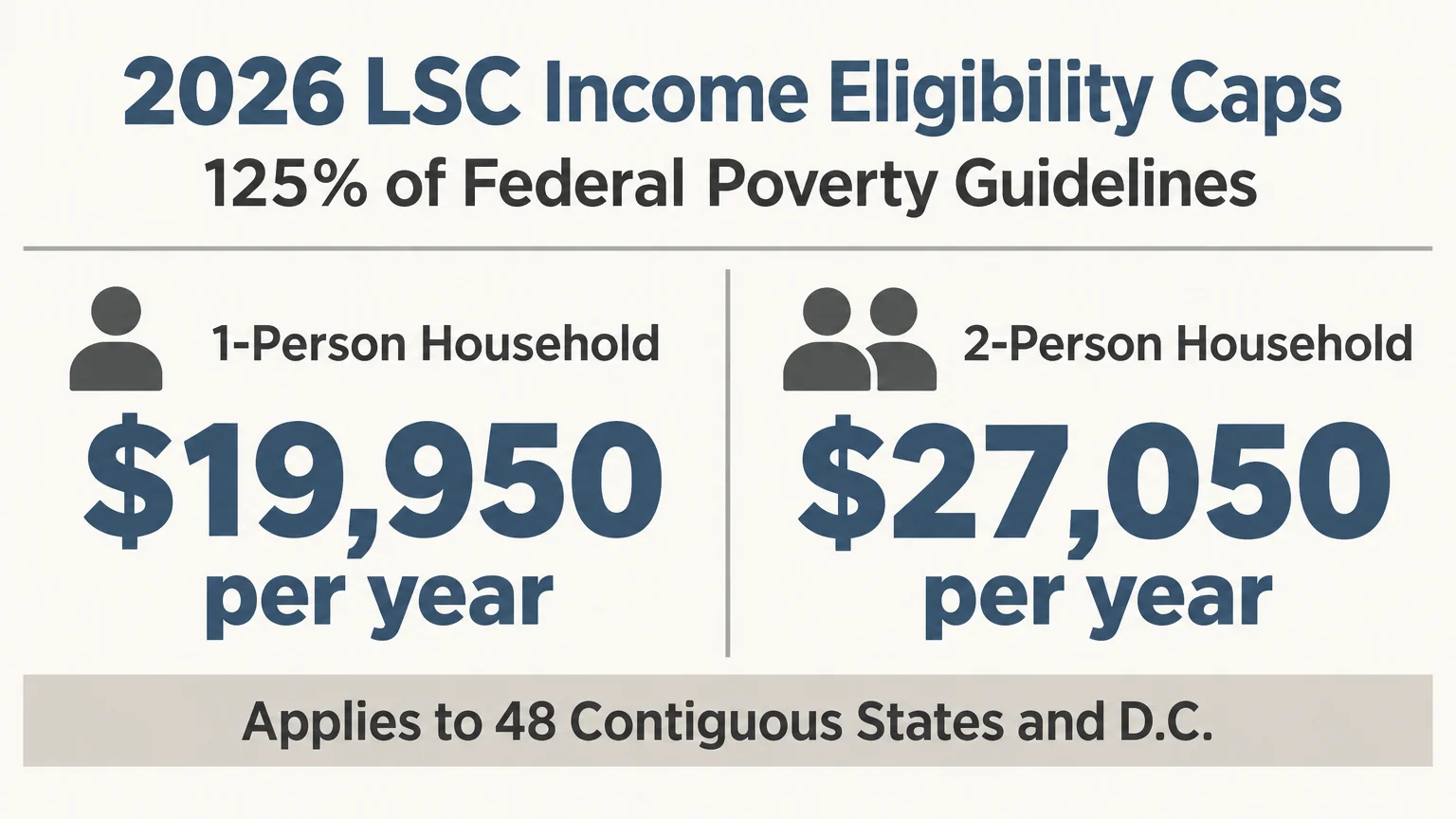
For broader civil disputes—like evictions, debt collection, or family law—contact one of the 129 nonprofit legal aid groups funded by the Legal Services Corporation. They operate over 800 offices across all 50 states, D.C., and U.S. territories.
In 2026, standard eligibility caps at 125% of federal poverty guidelines: $19,950 per year for one person or $27,050 for two in the 48 contiguous states and D.C. Thresholds are higher in Alaska ($24,938/$33,813) and Hawaii ($22,950/$31,113).
Local offices may stretch limits to 200% of poverty ($31,920 for one person) if you face heavy medical bills or fixed debts. They also typically exclude your primary home and essential car from asset reviews.
Programs also lift the 200% cap completely when helping you keep existing low-income benefits or when most of your income goes toward nursing home or medical bills.
Apply right away if you have an urgent deadline. Because grantees had to turn away 49% of eligible applicants in 2024 due to funding limits, early applications matter.
3. Virtual Advice Through ABA Free Legal Answers
If your income exceeds legal aid caps, try the American Bar Association’s ABA Free Legal Answers website. Volunteer lawyers answer civil questions in writing at no cost.
Most state portals serve households under 250% of poverty guidelines with liquid assets capped around $5,000 to $10,000. A separate federal portal helps veterans with VA benefits and discharge upgrades under that same income cap and a $10,000 asset limit.
4. Specialized Advocacy for Care, Pensions, and Medicare
Certain senior issues qualify for dedicated free help with no income test.
- Long-Term Care Ombudsman Program: Resolves complaints for nursing home and assisted living residents in all 50 states, D.C., Puerto Rico, and Guam regardless of age or income; call 1-800-677-1116.
- ACL Pension Counseling and Information Program: Six regional projects serving 29 to 30 states recover lost pensions free of charge, with referrals elsewhere via the Pension Rights Center.
- State Health Insurance Assistance Programs (SHIP): Provide free Medicare coverage and billing counseling.
- Senior Medicare Patrols (SMP): Call 1-877-808-2468 for free help spotting and reporting Medicare fraud.
Common Mistakes and How to Avoid Them
Avoiding a few common missteps makes it much easier to secure free legal services for seniors without unnecessary delays.
- Assuming you own too much to qualify: Older Americans Act offices ban asset tests, and civil legal aid usually excludes your primary home and car.
- Waiting for a crisis: Heavy demand creates waiting lists, so call as soon as you receive an eviction warning, foreclosure notice, or lawsuit.
- Calling the wrong agency: Civil legal aid does not handle criminal defense, and federally funded senior programs rarely take fee-generating injury lawsuits.
- Trusting unverified websites: Scammers sometimes advertise a free lawyer before charging hidden fees; stick to the Eldercare Locator or official legal aid portals.
- Calling unprepared: Gather leases, benefit denial letters, medical bills, and court notices beforehand so intake staff can spot urgent deadlines.
Keeping a simple folder with your lease, benefit letters, and court dates speeds up intake calls. Clear records also help volunteer lawyers spot urgent deadlines during a short consultation.
When to Consult a Professional
Free programs cover most civil crises, yet complex situations sometimes call for a private elder law attorney. Paid counsel makes sense for intricate estate plans or Medicaid asset-protection trusts.
According to the National Council on Aging and LegalShield, an attorney-drafted will averages around $733 to $735, living trust packages run $1,000 to $4,000, and full estate plans cost $2,000 to $5,000 or more.
Personal injury or nursing home neglect cases often use contingency fees, meaning you pay nothing upfront. For other matters, ask local bar associations about reduced-fee panels or limited-scope representation, where a lawyer reviews a single document.
When interviewing a private attorney, ask whether they offer a free initial consultation and request their fee structure in writing before signing anything.
For official information, consult government resources like USA.gov, the Consumer Financial Protection Bureau (CFPB), and the Federal Trade Commission (FTC).
For tax-related topics, refer to the IRS. For information on Social Security, visit the Social Security Administration.
Frequently Asked Questions (FAQs)
Can I get a free will or power of attorney?
Yes, many Older Americans Act offices and pro bono clinics draft basic wills, powers of attorney, and advance health care directives for free. Privately, powers of attorney run $200 to $500, while advance directives cost $200 to $1,000.
Will my Social Security or pension disqualify me from legal aid?
Not at an Older Americans Act program if you are 60 or older, because income cannot block eligibility. For income-capped civil legal aid, heavy medical costs or fixed debts may still qualify you up to 200% of poverty guidelines.
Does owning a house block me from free legal services for seniors?
No, owning your home rarely blocks you from help. Older Americans Act offices cannot check assets at all, and Legal Services Corporation grantees generally exclude a primary residence and essential vehicle.
What if my local legal aid office turns me away?
Ask intake staff for referrals to law school elder law clinics, ABA Free Legal Answers, or state bar reduced-fee panels. For Medicare, pension, or care-facility issues, contact SHIP, a regional pension project, or an ombudsman instead.
Disclaimer: The information provided on this website does not, and is not intended to, constitute legal advice; instead, all information, content, and materials available on this site are for general informational purposes only. Information on this website may not constitute the most up-to-date legal or other information. Readers of this website should contact their attorney to obtain advice with respect to any particular legal matter.