
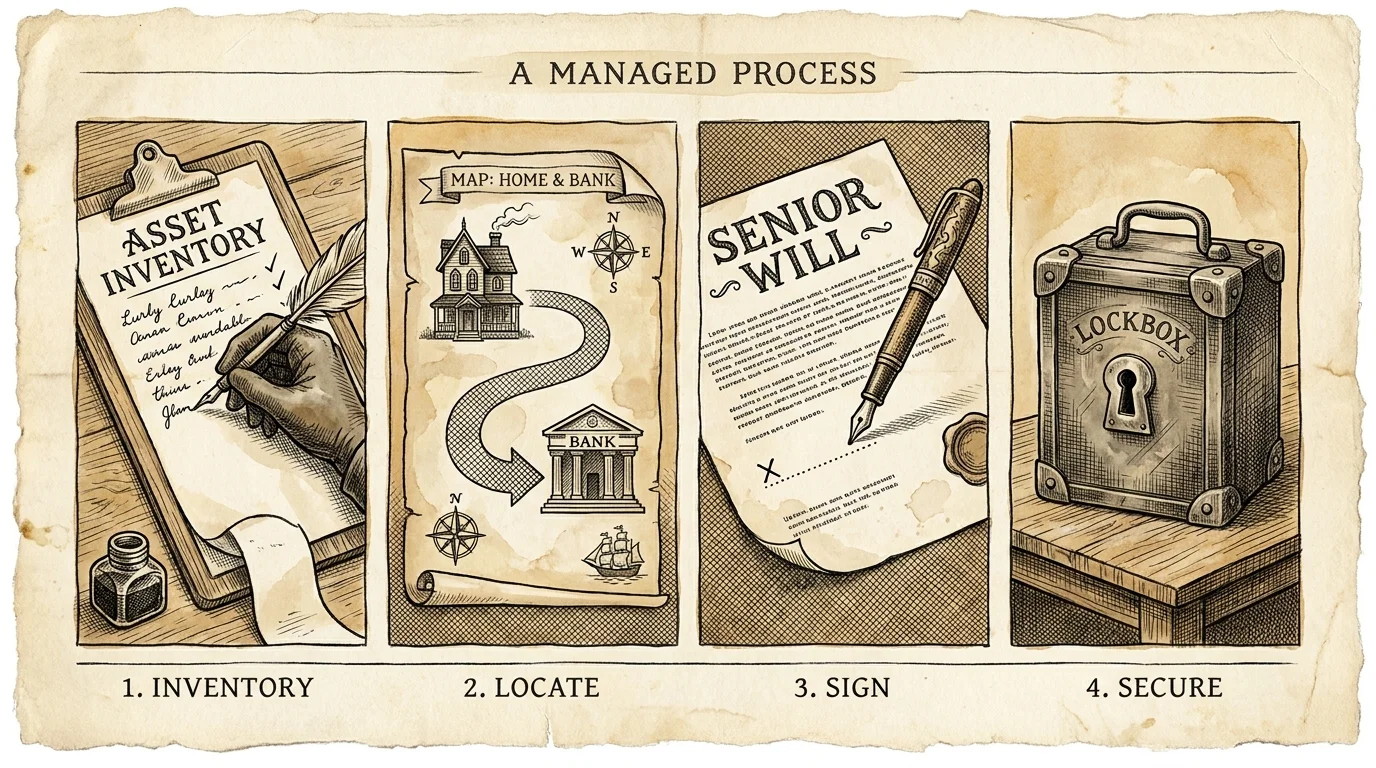
A Practical Guide to Creating or Updating Your Will
Translating your intentions into a legally binding document requires organization and attention to detail. This practical legal will guide outlines the systematic steps you should take to ensure your final wishes are comprehensively documented and legally sound.
Step 1: Conduct a Comprehensive Asset Inventory
Before you can decide who gets what, you must know exactly what you own. Walk through your home and document your physical belongings, then sit at your desk and outline your financial footprint. Your inventory should include real estate properties, vehicles, bank accounts, investment portfolios, retirement funds, and valuable personal property such as art, jewelry, or antiques. Do not overlook your digital assets—create a secure ledger of your online banking credentials, social media accounts, digital photo libraries, and cryptocurrency holdings. Providing a clear roadmap of your assets saves your executor hundreds of hours of frustrating investigative work.
Step 2: Identify and Document Liabilities
Your estate is responsible for settling your debts before any beneficiary receives a dime. Compile a list of all your liabilities, including your mortgage, auto loans, credit card balances, and any personal debts. Understanding your net worth—your assets minus your liabilities—gives you a realistic picture of what will actually be available for distribution to your loved ones.
Step 3: Select Your Fiduciaries Carefully
Naming an executor is not merely an honorary title; it is a demanding job. Look for someone highly organized, emotionally resilient, and geographically convenient if possible. It is also crucial to name at least one alternate executor in case your primary choice becomes incapacitated, predeceases you, or simply declines the responsibility when the time comes. If you have dependents or pets, you must also designate guardians. Pet trusts and guardianship clauses ensure your beloved companions are not sent to a shelter but are instead placed with someone who understands their dietary needs and temperament.
Step 4: Draft the Directives
When specifying who receives your property, be as precise as possible. Instead of writing, “I leave my jewelry to my daughters,” specify which pieces go to which individual to prevent arguments over subjective value. Furthermore, consider making charitable bequests. Leaving a percentage of your estate or a fixed dollar amount to a cause you supported during your lifetime is a powerful way to leave a lasting legacy.
Step 5: Execute the Document According to State Law
A will is merely a piece of paper until it is properly executed. Every state has strict requirements regarding how a will must be signed and witnessed. Generally, you must sign the document in the physical presence of at least two adult witnesses who are not named as beneficiaries in the will. These disinterested witnesses serve to verify that you were of sound mind and were not acting under duress. To further protect the document, attach a “self-proving affidavit” signed by a notary public; this eliminates the need for the court to track down your witnesses during the probate process years later.
Step 6: Ensure Safe Storage and Communication
Hiding your will in a secret location does no one any good if it cannot be found after you pass away. Store the original, signed document in a fireproof safe at your home or file it with your local probate court if your county offers that service. Safe deposit boxes can be problematic; if you are the sole owner of the box, the bank will seal it upon your death, and your family may require a court order just to retrieve the will. Most importantly, inform your executor precisely where the original document is located and how to access it.