
Moving a loved one into a long-term care facility requires immense emotional energy and vigilance. You must protect their legal rights and family savings before signing any facility paperwork.
Facilities often present a dense nursing home admission agreement during sudden, high-stress medical transitions. Many admissions offices push family members to sign immediately without reading the fine print.
Unlawful clauses hidden in these contracts can compromise your assets and diminish your loved one’s autonomy. Spotting nursing home contract red flags early preserves your rights and ensures dignified, high-quality care.
Key Concepts and Terminology Explained
Understanding long-term care contracts requires familiarity with standard legal terminology. Facilities frequently rely on complex language that obscures resident rights and family responsibilities.
A nursing home admission agreement serves as the binding contract between the resident and the facility. It outlines operational rules, covered services, basic costs, and resident discharge policies.
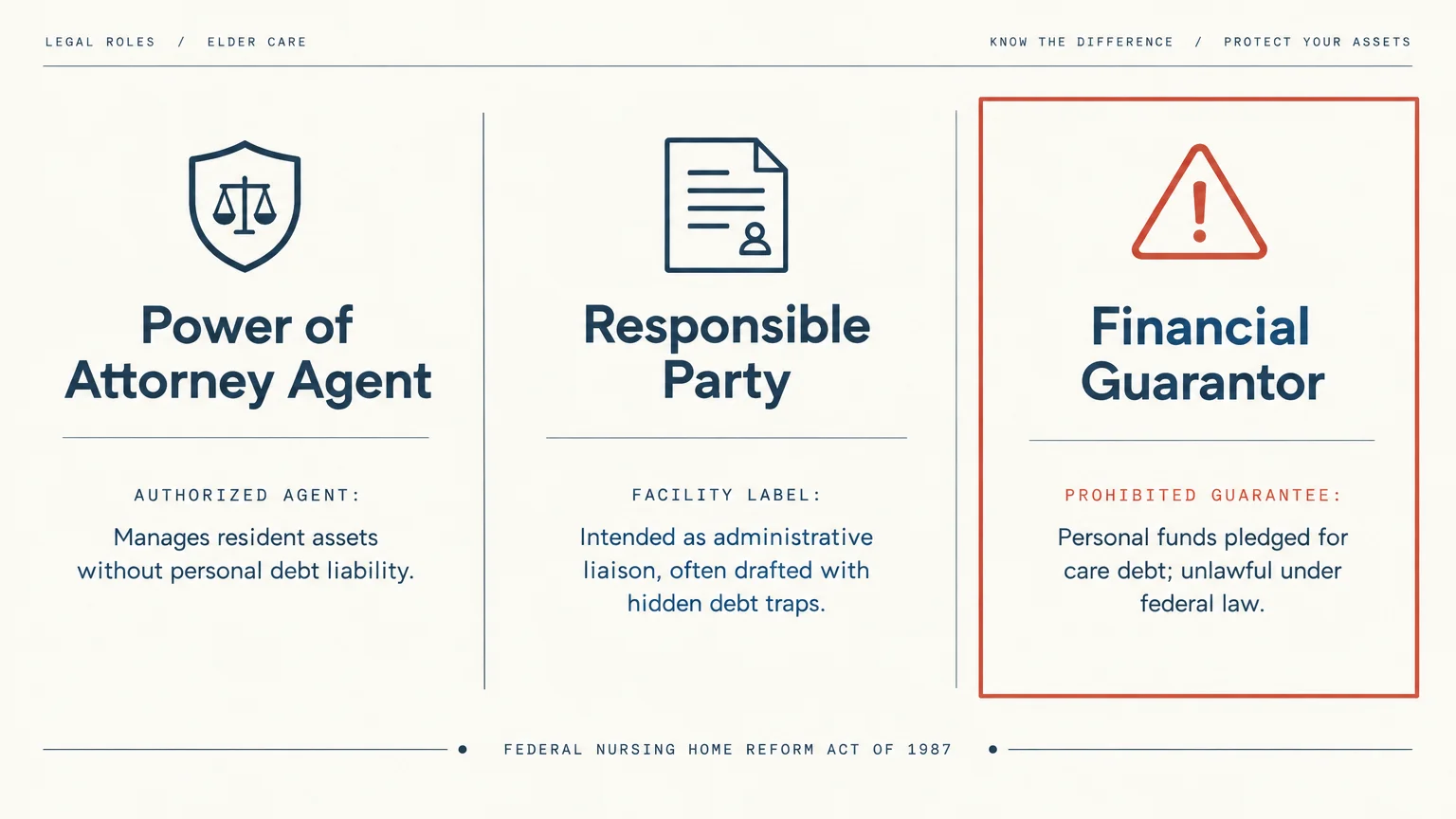
The term “responsible party” often appears throughout standard agreements. While facilities present this role as an administrative contact, contracts often draft it to impose personal financial liability.
A financial guarantor agrees to pay another person’s debts out of their own personal pocket. Federal law prohibits Medicare or Medicaid-certified facilities from demanding third-party financial guarantees.
A power of attorney gives a designated agent authority to manage financial or healthcare decisions. Acting as an agent never requires you to spend your own money on care costs.
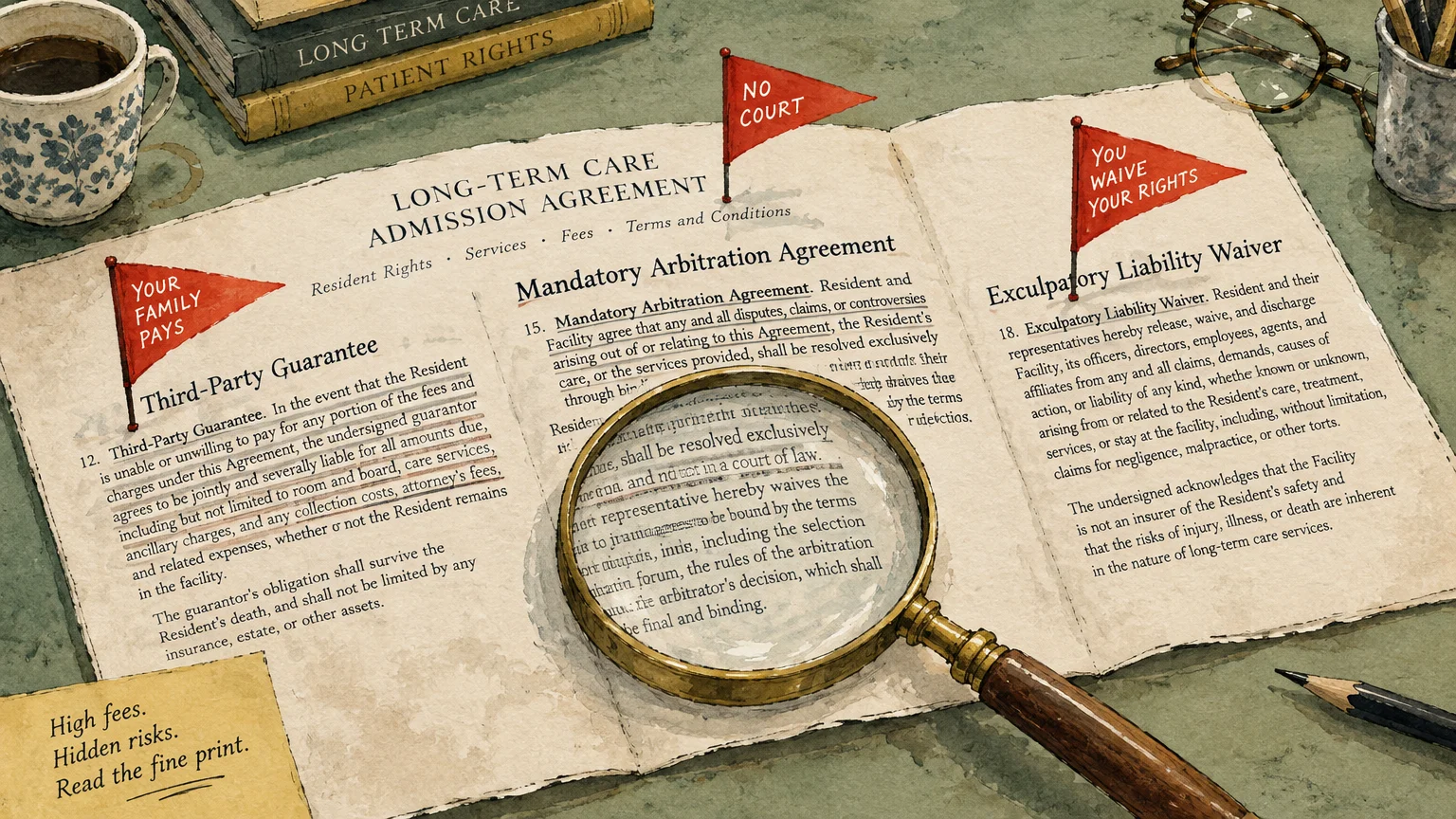
An arbitration clause nursing home document waives your constitutional right to take disputes to court. Instead, an independent arbitrator resolves negligence or contract disagreements outside public judicial oversight.
Exculpatory clauses attempt to release a facility from legal liability for its own negligence or misconduct. State and federal laws routinely deem these liability waivers completely unenforceable.
A bed-hold policy defines how long a facility preserves a resident’s room during temporary hospitalizations. These rules vary significantly depending on whether payment comes from Medicaid, Medicare, or private funds.
Involuntary discharge occurs when a facility evicts a resident against their wishes. Federal regulations strictly limit the legal justifications facilities may invoke to initiate this severe action.
Elder law represents a dedicated legal discipline focused on the unique challenges facing older adults. Elder law attorneys specialize in long-term care planning, asset protection, and resident rights enforcement.
A Practical Guide to 10 Legal Red Flags in a Nursing Home Contract
Navigating long-term care contracts requires careful scrutiny before signing your name. Look for these ten legal warning signs to protect your family from unfair liability and substandard care.
1. Third-Party Financial Guarantee Clauses
The most dangerous trap in any nursing home admission agreement involves third-party guarantee language. Facilities often label this section as a “Responsible Party” or “Sponsor” commitment.
Under the Federal Nursing Home Reform Act of 1987, certified nursing homes cannot require third-party financial guarantees. The law explicitly forbids facilities from forcing family members to assume personal debt.
Despite this clear federal ban, facilities continue inserting subtle language that makes signatories personally responsible. For example, a clause might state you agree to pay any unpaid balances if Medicaid denies coverage.
Consider a daughter named Sarah who signed an agreement for her ailing mother. The contract stated Sarah would personally ensure timely Medicaid application processing or pay out-of-pocket charges.
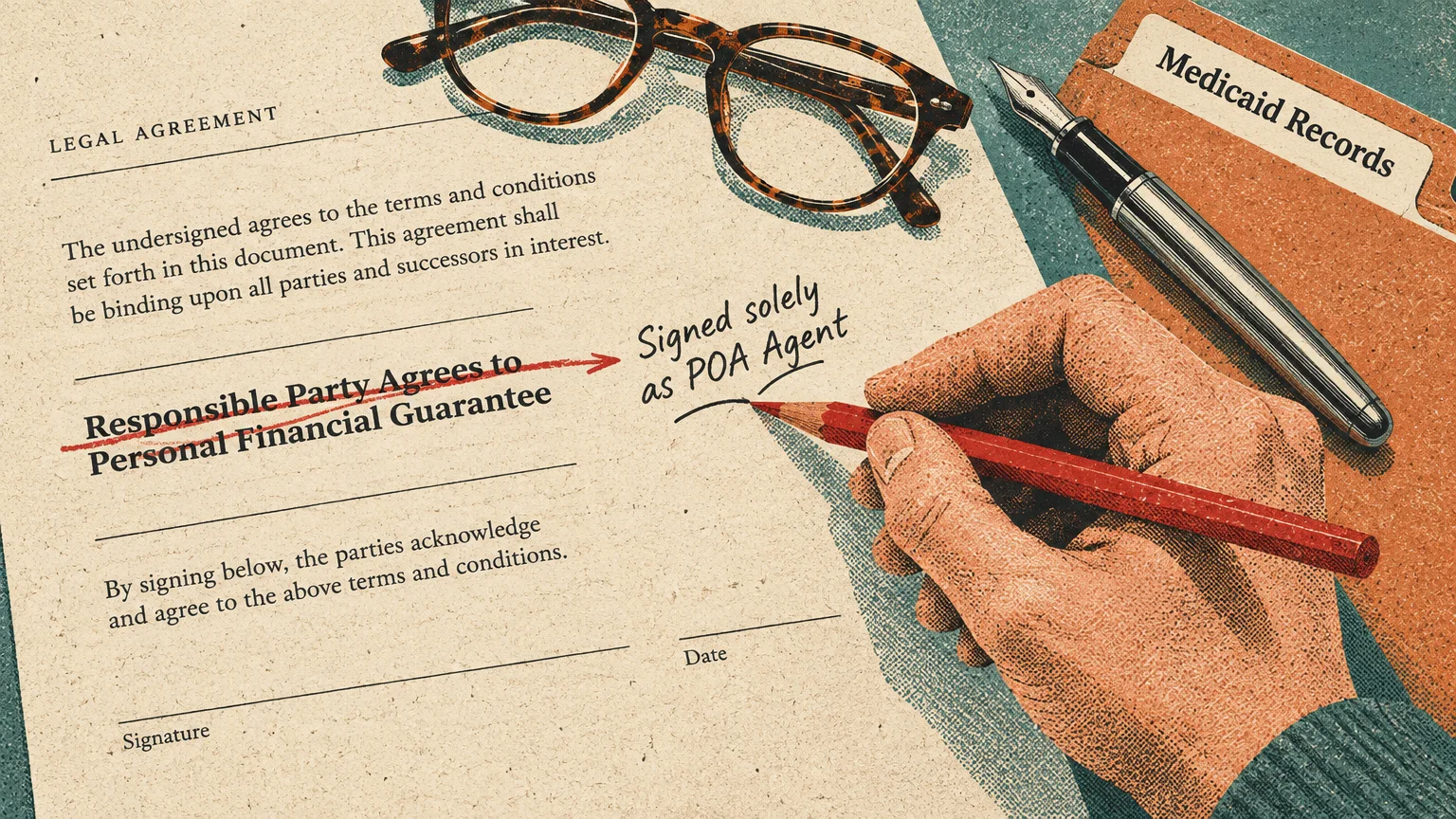
When a paperwork delay stalled the Medicaid application, the facility sued Sarah personally for sixty thousand dollars. You can avoid this by signing solely as an authorized power of attorney agent.
Always write the words “as agent” or “attorney-in-fact” beside your signature on every page. This simple distinction legally confirms you are managing your parent’s assets, not risking your own.
2. Mandatory Binding Pre-Dispute Arbitration Clauses
Many facilities include clauses requiring you to resolve future disputes through binding private arbitration. Signing this clause permanently strips away your constitutional right to a trial by jury.
Arbitration proceedings occur behind closed doors, hidden from public scrutiny and regulatory transparency. Private arbitration often limits discovery procedures, making it harder to prove physical neglect or abuse.
Arbitration firms are frequently selected and paid by the nursing home industry. This structural relationship creates an inherent risk of bias against residents and their grieving families.
The Centers for Medicare and Medicaid Services established clear rules regarding arbitration agreements. Facilities cannot compel you to sign an arbitration agreement as a mandatory condition of admission.
You maintain the legal right to decline any arbitration clause nursing home administrators present. Simply draw a clean line through the clause, write “declined,” and place your initials alongside.
Federal rules also grant you a thirty-day rescission window after signing. If you signed under admission pressure, submit a written revocation letter within thirty days.
3. Waivers of Facility Liability for Neglect, Theft, or Injury
Some contracts contain outrageous clauses attempting to waive all facility responsibility for resident safety. These provisions claim the facility bears no liability for falls, pressure ulcers, or wandering injuries.
Other clauses attempt to absolve management when staff members steal personal belongings, jewelry, or cash. Facilities possess a fundamental legal duty to maintain a safe, secure, and dignified environment.
Such exculpatory provisions violate basic contract law and established public policy across the nation. Courts consistently strike down clauses that attempt to shield corporations from their own negligence.
If a facility includes blanket liability waivers, treat it as a massive operational red flag. It indicates management values corporate immunity over resident welfare and rigorous safety standards.
Refuse to sign agreements containing blanket waivers of liability for bodily harm or property loss. Insist that management strike these illegal terms from the admission paperwork before proceeding.
4. Unlawful Restrictions on Medicaid or Medicare Conversion
Certain long-term care contracts demand that incoming residents pay private rates for a guaranteed timeframe. For instance, a clause might demand twelve or twenty-four months of private-pay status.
Federal law expressly prohibits certified facilities from requiring private-pay commitments from residents. Once an individual qualifies financially and medically for Medicaid, the facility must accept Medicaid reimbursement.
Similarly, facilities cannot threaten eviction simply because a resident transitions from private funds to Medicaid. If the facility participates in Medicaid, it cannot discriminate against residents based on payment source.
Watch for deceptive clauses labeled as “Medicaid Bed Availability Agreements.” Facilities sometimes falsely claim they have no open Medicaid beds to force continued out-of-pocket payments.
If a facility accepts Medicaid funding, any bed can legally qualify as a certified bed. Never sign any clause promising to delay your loved one’s legitimate Medicaid application.
5. Illegal Eviction and Involuntary Discharge Triggers
Federal regulations strictly govern when and how a nursing facility can evict a resident. A lawful discharge can only occur under six narrowly defined statutory circumstances.
These legal grounds include improved health, necessary medical treatments the facility cannot provide, or direct safety threats. Non-payment also serves as a ground, but only after proper administrative notice.
Red flag contracts frequently invent unauthorized grounds for involuntary eviction. Unlawful triggers include resident behavioral symptoms related to dementia, family grievances, or refusal to take specific medications.
Facilities must provide at least thirty days of written notice before any proposed involuntary transfer. That notice must contain specific appeal procedures and contact information for the state ombudsman.
Contracts that permit discharge with only twenty-four hours of notice violate federal standards directly. Reject any provision allowing unilateral termination of residency without complete due process protections.
6. Forfeiture of Personal Physician and Pharmacy Selection
Federal law guarantees every nursing home resident the right to select their personal attending physician. Contracts that mandate the exclusive use of facility-employed medical doctors violate statutory resident protections.
While an outside physician must comply with facility paperwork and licensing rules, facilities cannot ban them. Forcing an unfamiliar doctor onto a resident disrupts vital continuity of long-term medical care.
Similarly, beware of clauses forcing residents to purchase medications exclusively through the facility’s contracted pharmacy. These closed arrangements often charge excessive markups for ordinary prescription drugs.
Federal standards allow residents to obtain medications from any licensed pharmacy that meets packaging standards. Exercising your right to choose pharmacies can save hundreds of dollars each month.
Examine the medical services section of the contract with extreme care. Ensure the document explicitly preserves your loved one’s right to retain their trusted family physician.
7. Vague Fee Schedules and Hidden Surcharges
A nursing home contract must clearly state the daily or monthly basic care rate. Red flag agreements quote an attractive base rate while burying dozens of expensive ancillary charges.
Unscrupulous facilities add surcharges for routine assistance with dressing, bathing, or walking down hallways. Other agreements charge separate billing fees for delivering meal trays or dispensing daily medications.
Federal disclosure rules require facilities to provide a complete itemized schedule of all potential fees. You must receive written notification of any rate increases at least thirty days in advance.
Request a comprehensive, written itemization of every service covered under the basic daily room charge. Never sign a contract that leaves auxiliary pricing open to future unilateral adjustments.
8. Demands for Non-Refundable Upfront Deposits
Certain facilities demand large entrance fees, admission processing charges, or non-refundable security deposits. While continuing care retirement communities require entrance fees, standard skilled nursing facilities generally cannot.
For Medicaid-eligible individuals, asking for any upfront deposit or application fee violates federal law. Facilities participating in federal healthcare programs cannot solicit gifts or donations as admission prerequisites.
For private-pay residents, security deposits must remain strictly refundable under clear, written contractual parameters. The agreement should explicitly explain when and how the facility returns unused deposit funds.
If a resident transfers to a hospital or passes away, unearned fees must be returned promptly. Beware of contracts that claim all initial payments become permanently non-refundable upon signature.
9. Broad Authorization for Restraints and Sedation
Every resident maintains the fundamental legal right to live free from physical and chemical restraints. Restraints include physical ties, locked wheelchair trays, and sedative drugs used for behavioral management.
Red flag contracts sometimes conceal blanket consent waivers within the routine medical authorization paperwork. These sneaky clauses grant facility staff unilateral permission to administer psychotropic drugs without specific consultation.
Under federal regulations, facilities can never utilize restraints for discipline, convenience, or staff shortages. Restraints require a physician’s specific, time-limited written order following documented necessity and family consultation.
Read the general medical authorization clauses meticulously before signing your approval. Explicitly strike out any wording that grants broad consent for chemical sedation or mechanical restraints.
10. Forced Sign-Over of Income, Pensions, or Direct Asset Control
Facilities occasionally attempt to seize absolute financial control by demanding to become the resident’s Representative Payee. This allows the facility to receive Social Security or pension checks directly into its accounts.
Federal law expressly forbids nursing facilities from demanding direct control over resident benefit funds. The Social Security Administration maintains strict guidelines to ensure beneficiaries or their families manage payments.
Furthermore, facilities cannot compel residents to deposit their personal allowance funds into a facility-managed bank account. Residents or their designated agents retain full legal autonomy over their private financial holdings.
If a contract contains a mandatory power of attorney or representative payee clause, refuse it immediately. Maintaining direct control over your funds prevents administrative abuse and ensures independent financial oversight.
Common Mistakes and How to Avoid Them
Admissions often occur during overwhelming medical crises, such as sudden strokes or severe fractures. These high-stress moments make families particularly vulnerable to signing predatory legal agreements.
Understanding the most frequent contracting mistakes empowers you to protect your family’s financial future. Avoiding these common errors ensures you maintain control over care standards and legal rights.
Mistake 1: Signing Admission Papers Under Emergency Pressure
Hospital discharge planners and nursing home intake coordinators often demand instant contract signatures. They may claim the bed will be lost unless you sign all paperwork within hours.
You always have the legal right to take documents home for thorough examination. Never let administrative deadlines rush you into executing complex, multi-page legal agreements without careful thought.
Request a clean digital copy of the entire admission packet before your loved one arrives. Review each provision in a calm setting away from stressful hospital discharge lounges.
Mistake 2: Signing Personal Names Without Fiduciary Clarification
Signing your individual name on a signature line creates severe ambiguity regarding financial liability. Collection agencies exploit this ambiguity by arguing you accepted personal responsibility for all care charges.
Always write your official legal title alongside your signature on every single document page. Use the precise format: “Jane Doe, Power of Attorney for John Doe.”
This practice establishes an undeniable record that you are acting solely in a representative capacity. It legally shields your private bank accounts, real estate, and wages from nursing home collections.
Mistake 3: Relying on Oral Promises That Contradict Written Text
Admissions coordinators frequently make comforting oral statements to ease family anxieties during admission. They may assure you that certain fees are waived or that rooms are guaranteed.
Standard contracts contain integration clauses stating written words supersede all previous verbal discussions. If an oral promise is omitted from the contract, courts will rarely enforce it.
Insist that admissions staff write every verbal accommodation directly onto the contract face. Have the admissions director initial each addition before you sign the finalized agreement.
Mistake 4: Believing Admission Agreements Are Non-Negotiable
Many people assume nursing home agreements are rigid, take-it-or-leave-it contracts that cannot be modified. In reality, contracts are negotiable legal instruments subject to mutual review and revision.
You have every right to cross out illegal, unfair, or voluntary contract terms. Simply draw a line through objectionable clauses, write your initials, and insert the current date.
If a facility refuses to accept reasonable edits to voluntary terms, consider alternate care providers. A facility unwilling to respect basic rights during admission often provides substandard ongoing care.

When to Consult a Professional
Navigating the intersection of contract law, healthcare regulations, and public benefits requires deep expertise. Consulting professional advocates ensures your family avoids devastating legal mistakes.
An elder law attorney provides invaluable guidance before you execute any long-term care contracts. These attorneys review admission agreements, protect family assets, and ensure Medicaid qualification compliance.
You should consult an elder law attorney immediately if a contract contains ambiguous guarantee clauses. Legal counsel is also essential if a facility threatens involuntary discharge or sues for unpaid bills.
Every state operates a Long-Term Care Ombudsman Program dedicated to advocating for resident welfare. Ombudsmen serve as free, confidential public resources who investigate resident complaints and clarify legal rights.
Contact your local ombudsman if a facility pressures you to sign an arbitration agreement. They can also assist if management attempts an improper eviction or restricts physician access.
If you suspect serious regulatory violations, contact your state health licensing agency. State inspectors possess authority to investigate facility violations, issue official citations, and mandate corrective actions.
Frequently Asked Questions (FAQs)
Can a nursing home deny admission if I refuse an arbitration clause?
Under federal regulations, certified nursing homes cannot deny admission solely because you decline an arbitration clause. Signing an arbitration agreement must remain entirely voluntary under Centers for Medicare and Medicaid Services rules.
If an intake coordinator claims arbitration is mandatory, ask to speak with the facility director. You can report non-compliant facilities directly to your state health department or the long-term care ombudsman.
Can adult children be forced to pay their parents’ nursing home bills?
The Federal Nursing Home Reform Act prohibits certified facilities from requiring adult children to guarantee payments. However, roughly thirty states maintain ancient filial responsibility laws that theoretically require adult children to support indigent parents.
While filial laws are rarely enforced, predatory facilities sometimes attempt to exploit them during collections. Never sign documents agreeing to personal liability, and consult an elder law attorney if targeted.
What should you do if you already signed a contract with illegal terms?
Illegal contract clauses remain legally unenforceable, even after you sign the admission document. State and federal statutes override conflicting contractual terms that violate resident rights or public policy.
For voluntary arbitration clauses, you usually have a thirty-day window to provide written notice of rescission. An elder law attorney can help you nullify improper terms and assert your statutory protections.
How much advance notice must a facility give before an eviction?
Federal regulations mandate that nursing homes provide at least thirty days of advance written notice before initiating discharge. The notice must clearly outline the specific transfer destination and detail your administrative appeal rights.
Immediate or short-notice discharges are strictly limited to severe emergency health improvements or direct physical threats. Filing an administrative appeal automatically stops the discharge process until a formal hearing takes place.
Can a nursing home require private-pay rates before accepting Medicaid?
Requiring an applicant to pay private rates for a specified duration violates federal law. Facilities certified under Medicaid cannot condition admission or continued residency on a promise to pay privately.
Once Medicaid approves coverage, the facility must accept the state-approved Medicaid reimbursement rate as full payment. Charging additional supplement fees to make up the difference between private and Medicaid rates is illegal.
For official information, consult government resources like USA.gov, the Consumer Financial Protection Bureau (CFPB), and the Federal Trade Commission (FTC).
For tax-related topics, refer to the IRS. For information on Social Security, visit the Social Security Administration.
Disclaimer: The information provided on this website does not, and is not intended to, constitute legal advice; instead, all information, content, and materials available on this site are for general informational purposes only.
Information on this website may not constitute the most up-to-date legal or other information. Readers of this website should contact their attorney to obtain advice with respect to any particular legal matter.