
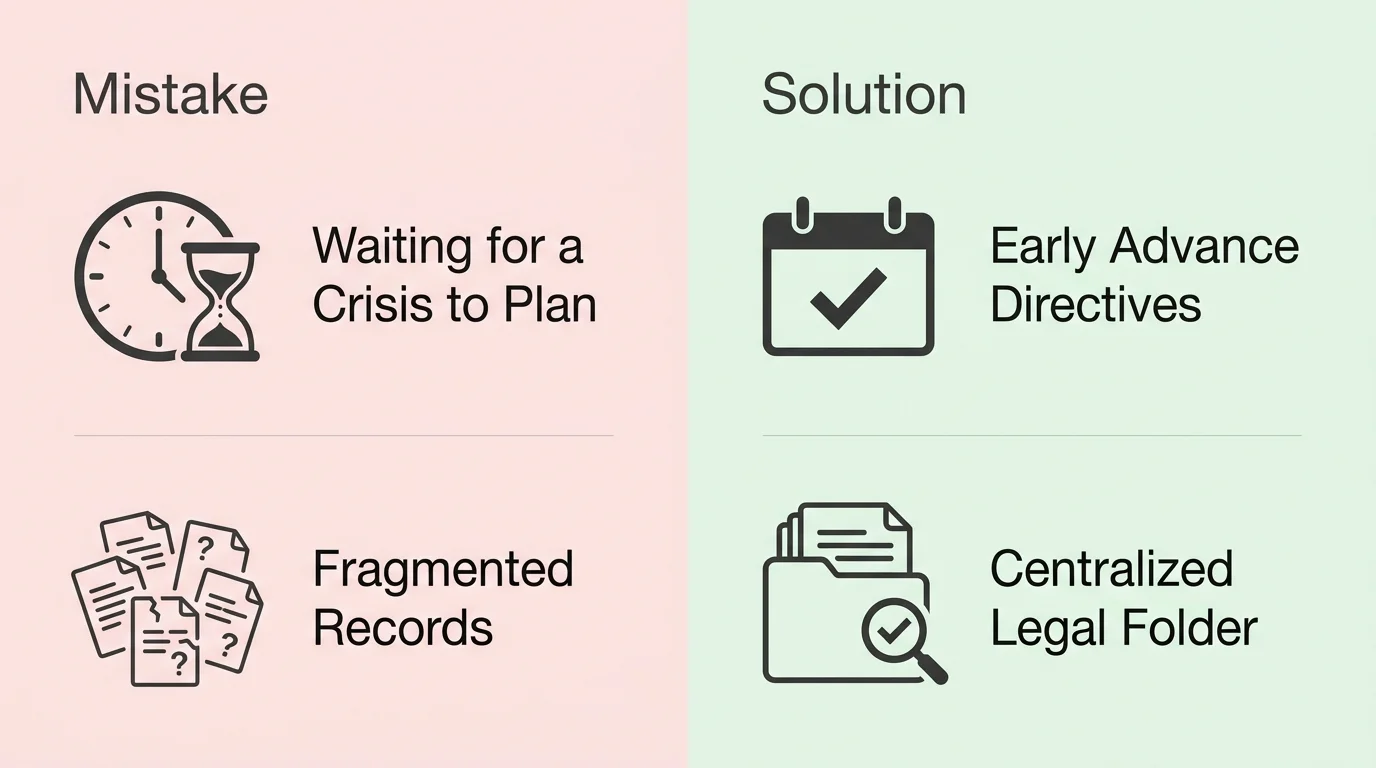
Common Mistakes and How to Avoid Them
Navigating elder law involves complex paperwork and high-stakes decisions. Families frequently make well-intentioned errors that inadvertently trigger financial losses, legal disputes, or compromised medical care. By recognizing these common pitfalls, you can protect your assets and your autonomy.
Failing to Establish Advance Directives While Healthy
Many individuals delay drafting a Durable Power of Attorney or a Health Care Surrogate until a medical emergency strikes. If a stroke or severe dementia suddenly incapacitates you, you lose the legal capacity to sign these documents. At that point, your family cannot simply step in to manage your bank accounts or make certain medical decisions; they must petition a court for formal guardianship. Guardianship strips you of your civil rights, costs thousands of dollars in legal fees, and subjects your family to strict court oversight. You avoid this entirely by executing comprehensive advance directives while you are fully healthy and legally competent.
Adding Adult Children as Joint Owners on Bank Accounts
You might add your son or daughter to your checking account so they can write checks and pay your bills if you become hospitalized. This represents a massive financial risk. Once you place an adult child on your account as a joint owner, the money legally belongs to both of you. If your child gets into an at-fault car accident, files for bankruptcy, or goes through a bitter divorce, their creditors or ex-spouse can legally seize the funds in that joint account to satisfy their debts. Instead of joint ownership, execute a Durable Power of Attorney authorizing your child to manage the account, or establish a “Payable on Death” (POD) designation so the funds transfer to them only after you pass away.
Signing Admission Agreements Without Reviewing Arbitration Clauses
When a family member enters a nursing home, the facility presents a thick stack of admission paperwork. Hidden within these pages, facilities frequently include binding arbitration agreements. By signing these clauses, you waive your constitutional right to sue the facility in civil court before a jury if they abuse or neglect you; instead, you agree to settle disputes through a private arbitrator chosen by the facility. Under federal guidelines, a nursing home cannot force you to sign an arbitration agreement as a condition of admission. Read every document carefully, cross out the arbitration clause, and refuse to sign that specific section.
Assuming Medicare Pays for Long-Term Custodial Care
A pervasive myth suggests that Medicare will cover the cost of moving into an assisted living facility or a nursing home. Medicare functions as health insurance; it pays for acute medical needs, hospitalizations, and short-term rehabilitation therapies. It does not pay for long-term “custodial care”—help with bathing, dressing, eating, and basic mobility. If you require long-term facility care, you must pay out-of-pocket, utilize a long-term care insurance policy, or qualify for Florida Medicaid. Because Medicaid imposes strict asset and income limits, proactive legal planning is necessary to protect your life savings from being entirely depleted by nursing home costs.