
Raising stepchildren brings immense joy and complex financial responsibilities, particularly when navigating federal support programs. Understanding how Social Security benefits for stepchildren work ensures your blended family receives every dollar of entitled financial assistance. The Social Security Administration provides auxiliary and survivor payments to qualifying stepchildren, but navigating the strict rules—including marriage duration requirements, financial support thresholds, and benefit caps—can feel overwhelming. You can protect your family’s financial future by learning the exact eligibility criteria, legal definitions, and application steps. This comprehensive guide breaks down complex federal regulations into actionable advice for your household, helping you secure vital financial stability.
Key Concepts and Terminology Explained
Navigating the federal benefits system requires a clear understanding of specific legal definitions and administrative rules. The Social Security Administration (SSA) maintains distinct criteria for stepchildren compared to biological or legally adopted children. To evaluate your household’s stepchild eligibility Social Security status, you must first familiarize yourself with the foundational terms and regulations that govern these claims.
Auxiliary Benefits vs. Survivor Benefits
Social Security benefits for stepchildren fall into two primary categories depending on the stepparent’s status:
- Auxiliary Benefits (Living Worker): When a stepparent begins receiving Social Security disability or retirement benefits, their eligible dependents—including stepchildren—may receive monthly auxiliary payments based on the stepparent’s earnings record.
- Survivor Benefits (Deceased Worker): If a stepparent passes away after earning sufficient work credits, eligible stepchildren can receive stepchild survivor benefits explained under federal law to help replace lost household income.
Primary Insurance Amount (PIA) and Benefit Limits
The Primary Insurance Amount (PIA) represents the monthly benefit worker receives at full retirement age, or the base calculation for disability payments. The SSA uses the stepparent’s PIA to determine dependent payouts:
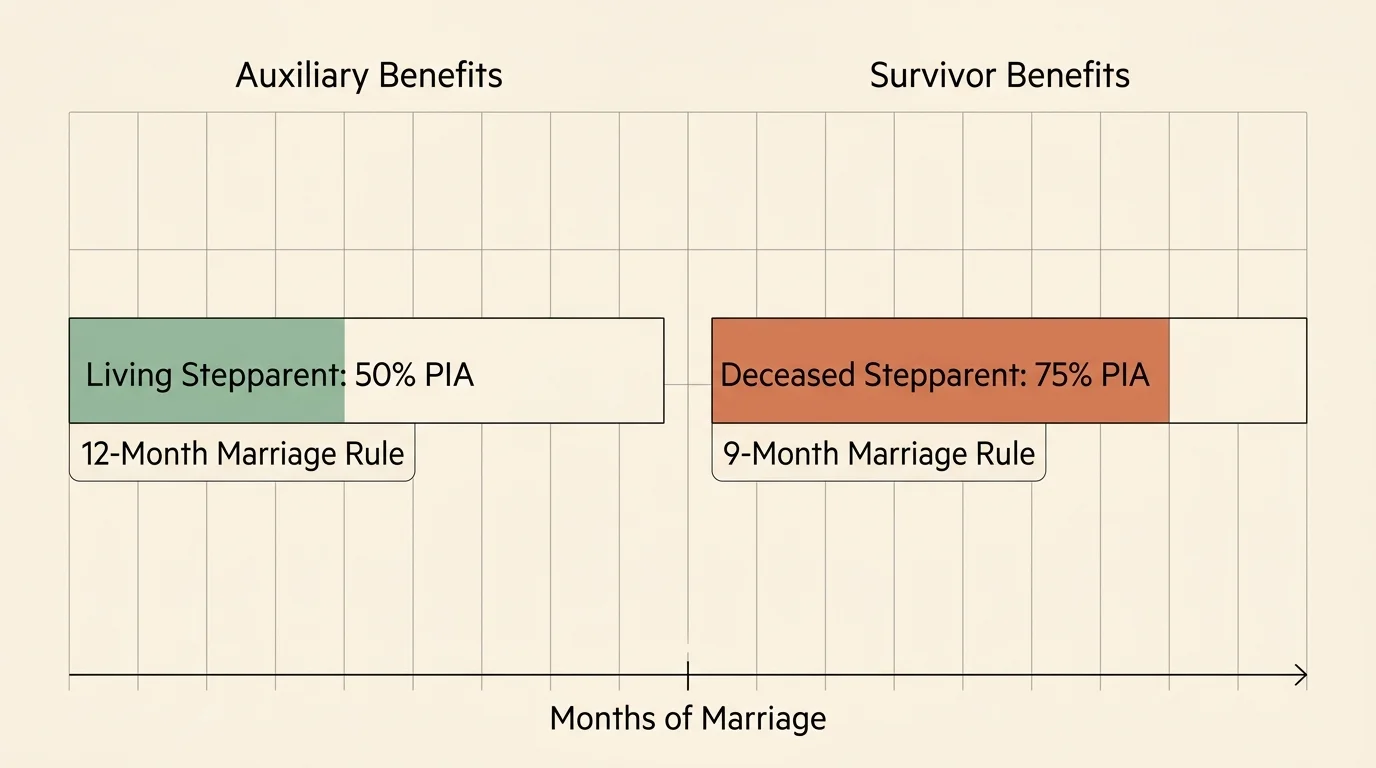
- Living Stepparent: An eligible stepchild can receive up to 50% of the stepparent’s PIA.
- Deceased Stepparent: An eligible stepchild can receive up to 75% of the deceased stepparent’s PIA in survivor benefits.
The 50% Financial Support Rule
Unlike biological children, who are automatically presumed dependent under federal law, stepchildren must satisfy a strict financial test. Under the Contract with America Advancement Act of 1996 and SSA regulations (20 CFR 404.363), a stepchild must have received at least 50% (one-half) of their financial support from the stepparent. The SSA evaluates this support at specific benchmark moments: the time you apply for benefits, the onset of the stepparent’s disability, the stepparent’s retirement, or the time of the stepparent’s death.
Marriage Duration Requirements
How stepchildren qualify for benefits heavily depends on the length of the marriage between the biological parent and the stepparent prior to claiming benefits:
- 12-Month Rule for Auxiliary Benefits: To claim benefits on a living stepparent’s retirement or disability record, the stepparent and the natural parent must have been legally married for at least 1 year (12 consecutive months) before filing the application.
- 9-Month Rule for Survivor Benefits: To qualify for survivor benefits following a stepparent’s death, the marriage must have lasted for at least 9 months immediately before the stepparent passed away. The SSA waives this 9-month requirement if the stepparent’s death was accidental or occurred in the line of active military duty.
The Family Maximum Benefit Cap
Federal law limits the total amount of money a single family can collect on one worker’s earnings record. The Family Maximum Benefit cap typically ranges between 150% and 188% of the worker’s full Primary Insurance Amount. If the total combined payments for the worker, spouse, biological children, and stepchildren exceed this threshold, the SSA proportionally reduces each dependent’s monthly payment until the total fits under the cap. The primary worker’s benefit is never reduced.
Age Eligibility and Disability Rules
Social Security family benefits stepchildren receive do not continue indefinitely. Standard child benefits end when the stepchild turns 18 years old. However, two important exceptions extend this timeline:
- Full-Time High School Students: Benefits continue until the child graduates or reaches age 19, whichever comes first, provided the child remains a full-time elementary or secondary school student (grade 12 or below).
- Disabled Adult Child (DAC) Benefits: If a stepchild has a qualifying severe physical or mental disability that began before age 22, they may continue receiving stepchild benefits into adulthood for as long as the disability persists.
Automatic Termination Upon Divorce
A crucial distinction for stepchildren involves marital dissolution. Under SSA regulations effective for divorces finalized in or after July 1996 (§ 331.3), a stepchild’s entitlement to benefits on a stepparent’s record automatically terminates the month after the divorce between the biological parent and the stepparent becomes final. This termination occurs unless the stepparent legally adopted the child prior to or during the divorce proceedings.