
You can challenge medical charges and protect your retirement savings by exercising your federal Medicare billing rights. Understanding these rules ensures you never pay more than the law permits.
Healthcare providers frequently send confusing statements that misstate what you actually owe. Federal regulations establish strict boundaries to safeguard your finances against unauthorized fees and unexpected medical bills.
Knowing your legal entitlements transforms complicated paperwork into manageable choices. Here is what you need to know to defend your wallet and assert your rights under Medicare.
Key Concepts and Terminology Explained
Navigating healthcare statements requires familiarity with basic insurance terms. Grasping these foundational definitions helps you spot medicare billing errors quickly.
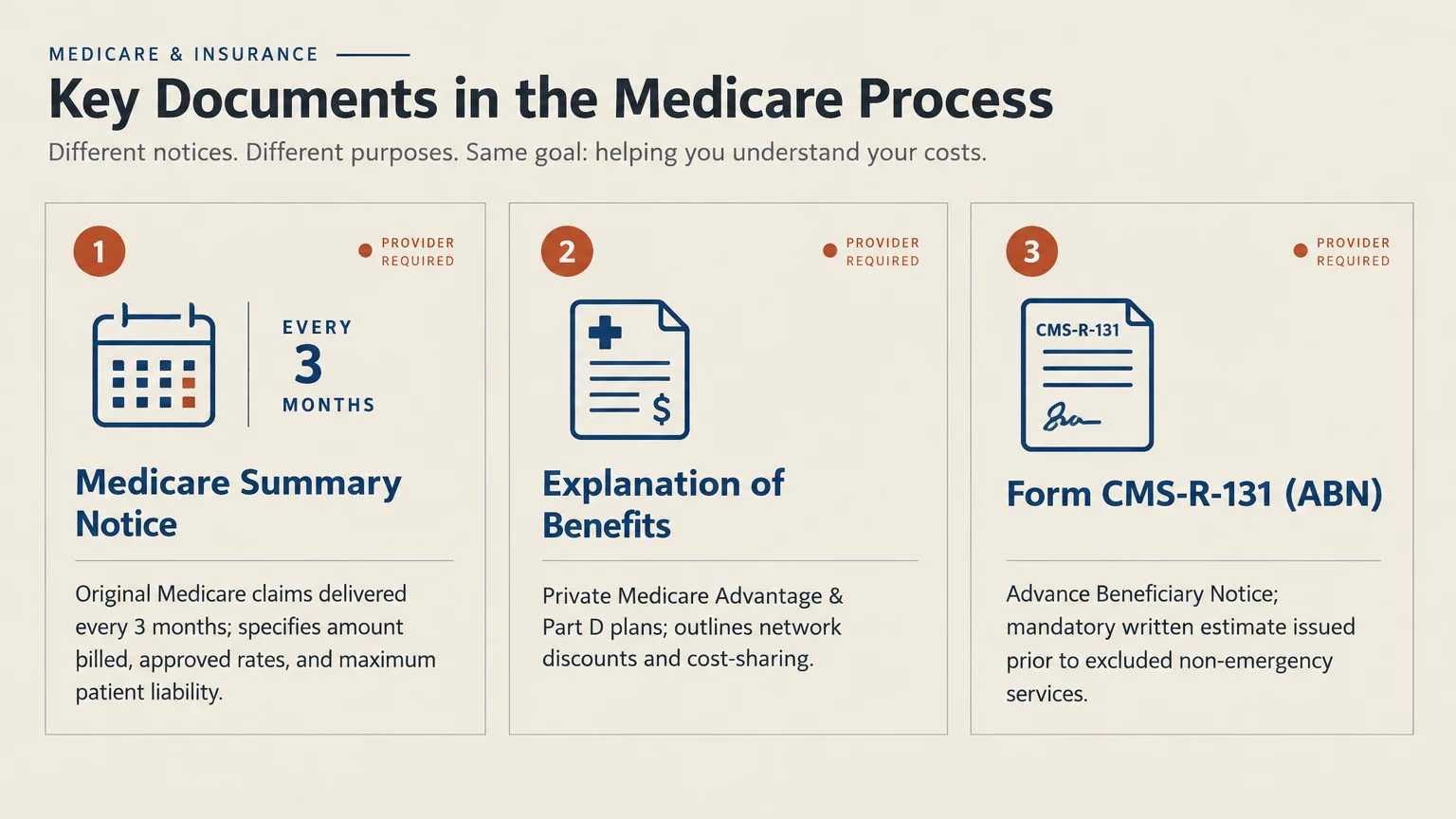
A Medicare Summary Notice arrives every three months for Original Medicare claims. It lists the services you received, the amount billed, what Medicare approved, and your maximum financial obligation.
Private insurers administering Medicare Advantage or Part D prescription plans send an Explanation of Benefits. Like a summary notice, it records charges, negotiated discounts, and your specific share of costs.
Assignment refers to an agreement between healthcare providers and Medicare. When doctors accept assignment, they agree to take Medicare-approved rates as payment in full for covered treatments.
Participating providers sign formal agreements to accept assignment on every Medicare claim. Non-participating doctors enroll in Medicare but decide whether to accept assignment on a claim-by-claim basis.
Balance billing occurs when a healthcare practitioner demands payment for the remaining difference between their standard fee and Medicare-approved charges. Federal statutes strictly restrict this practice.
An Advance Beneficiary Notice of Noncoverage is a mandatory disclosure document. Original Medicare providers must give you this written form before delivering services they believe Medicare will not cover.
The Amount in Controversy represents the dollar value of disputed medical coverage. You must meet specific minimum financial thresholds to advance through higher levels of the formal appeals process.
The Qualified Medicare Beneficiary program is a state Medicaid initiative for low-income seniors. It covers Medicare premiums, deductibles, and cost-sharing while prohibiting any provider billing.
Observation status means a hospital treats you as an outpatient while evaluating your health. Even if you sleep in a hospital bed, outpatient classification drastically alters your cost-sharing rules.

A Practical Guide to Your 11 Medicare Billing Rights
Federal statutes and administrative regulations establish powerful consumer safeguards for older adults. You can protect medicare rights effectively by understanding these eleven concrete legal protections.
1. The Right to Prior Written Notice of Denials (The ABN Rule)
Under Original Medicare, healthcare providers cannot surprise you with bills for services Medicare normally excludes. They must issue Form CMS-R-131, known as the Advance Beneficiary Notice of Noncoverage, before providing treatment.
This notice must explain why the clinician believes Medicare will deny coverage. It must also provide a realistic cost estimate and allow you to select whether to proceed.
If a doctor neglects to issue a proper notice beforehand, federal law protects you completely. You bear zero financial liability if Medicare subsequently denies the claim based on medical necessity rules.
Providers cannot present this notice during medical emergencies or bury it among standard admission paperwork. A valid notice requires clear communication, your explicit choice, and your signed acknowledgment.
2. The Right to Protection from Balance Billing
Participating physicians agree to take Medicare assignment as payment in full. This commitment means they cannot bill you for any amount beyond your statutory deductible and coinsurance.
For example, if a participating cardiologist charges $500 for a consultation and Medicare approves $200, the doctor must write off the remaining $300 difference. They cannot demand that balance from you.
Your responsibility remains limited to your standard 20% coinsurance after meeting your annual Part B deductible. Demanding extra payments violates federal provider agreements and triggers federal penalties.
Always confirm your physician’s participating status before scheduling elective procedures. Doing so protects your budget from illicit surcharges and preserves your statutory medicare patient rights.
3. The Right to Strict Limiting Charges from Non-Participating Doctors
Some doctors accept Medicare patients without agreeing to accept assignment on every service. These non-participating physicians can bill more than the Medicare fee schedule, but their fees remain strictly capped.
Federal law establishes a 15% limiting charge rule. Non-participating doctors receive 95% of the standard fee schedule amount, and they cannot charge more than 15% above that reduced baseline.
In total, a non-participating practitioner can never charge you more than 109.25% of the standard Medicare-approved rate. Any dollar billed beyond this legal threshold constitutes an illegal overcharge.
Furthermore, non-participating practitioners must submit claims directly to Medicare on your behalf; they cannot force you to file the paperwork yourself. Medicare then pays you back directly.
4. The Right to Absolute Billing Immunity for QMB Enrollees
Seniors enrolled in the Qualified Medicare Beneficiary program hold the strongest billing protections in healthcare. Federal statute strictly forbids any provider from balance billing a QMB recipient.
This statutory ban covers all Medicare Part A and Part B deductibles, coinsurance, and copayments. You owe exactly zero dollars for covered Medicare care when enrolled in this program.
Even if your state Medicaid program pays nothing to the healthcare professional, the doctor cannot bill you. Providers who attempt to collect these amounts violate federal law and risk severe sanctions.
Carry your state Medicaid card alongside your Medicare card at every medical appointment. Remind administrative staff that balance billing QMB enrollees constitutes an actionable federal regulatory violation.
5. The Right to Challenge Hospital Observation Status
Hospitals frequently place seniors under outpatient observation rather than admitting them as inpatients. This classification historically stripped patients of skilled nursing coverage and generated massive outpatient bills.
Following the landmark federal court mandate in Alexander v. Azar, Original Medicare beneficiaries enjoy critical appeal rights. You can formally challenge your reclassification from an inpatient to an outpatient receiving observation services.
Hospitals must deliver Form CMS-10868, the Medicare Change of Status Notice, at least four hours before discharge. This document alerts you to your outpatient classification and outlines your right to an expedited appeal.
Additionally, facilities must provide the updated Medicare Outpatient Observation Notice by April 20, 2026, for stays exceeding 24 hours. Your regional Beneficiary and Family Centered Care Quality Improvement Organization reviews these appeals rapidly.
Keep in mind that the historic window to file retrospective appeals for past stays dating back to 2009 closed on January 2, 2026. Any late retrospective filings now require proving good cause.
6. The Right to a Five-Tiered Appeals Process
Whenever Medicare denies coverage for an item or service, you have a statutory right to appeal. The Original Medicare appeals process features five distinct administrative levels designed to protect your interests.
Level 1 involves a Redetermination by a Medicare Administrative Contractor. You must submit your written appeal within 120 days of receiving your Medicare Summary Notice, and the contractor must decide within 60 days.
Level 2 allows a Reconsideration by a Qualified Independent Contractor if Level 1 fails. You must file this request within 180 days of receiving the initial redetermination decision.
Level 3 brings your case before an Administrative Law Judge through the Office of Medicare Hearings and Appeals. To qualify, your disputed claim must meet an Amount in Controversy threshold of $200.
You must file for an Administrative Law Judge hearing within 60 days of your Level 2 denial. This $200 threshold remains unchanged for 2027, preserving accessible legal reviews for modest claims.
Level 4 provides a review by the Medicare Appeals Council within 60 days of the judge’s ruling. Level 5 enables judicial review in Federal District Court within 60 days of the council’s decision.
Federal District Court reviews require meeting higher financial stakes. The Amount in Controversy threshold sits at $1,960, increasing to $2,000 for 2027.
7. The Right to Correct Clerical Errors Without Formal Appeals
Not every disputed medical bill requires an exhausting five-tier administrative battle. Billing departments frequently commit minor typographical errors, transposition mistakes, or incorrect procedure code entries.
Federal rules provide an administrative remedy known as a clerical error reopening for Part B claims. You or your physician can request this correction directly from the claims processor.
You must submit a clerical reopening request within one year of the initial determination date. This streamlined mechanism fixes minor clerical mistakes swiftly without consuming your formal appeal deadlines.
Review every line item on your quarterly statement to detect these simple human slipups. Contacting the provider’s billing office promptly often resolves erroneous charges within a few business days.
8. The Right to 72-Hour Expedited Decisions for Urgent Needs
Standard administrative reviews can take weeks, but critical medical care cannot wait. Medicare Advantage and Part D prescription plans provide strict expedited appeal timelines for urgent situations.
You have 60 days from receiving an initial coverage denial notice to file an appeal. If your physician states that waiting threatens your life or health, the plan must expedite the review.
Under expedited rules, the insurer must issue a binding decision within 72 hours. This rapid timeline applies to both initial coverage determinations and pharmacy benefit disputes.
Ask your physician to submit written medical records supporting your expedited request directly to the plan. Clear medical documentation accelerates the decision and prevents administrative delays.
9. The Right to Protection Under the $2,100 Part D Out-of-Pocket Drug Cap
Prescription drug expenses once threatened seniors with catastrophic, open-ended retail pharmacy costs. Significant federal reforms now place an absolute ceiling on covered outpatient medications under Medicare Part D.
Your annual out-of-pocket spending on covered Part D medications is legally capped at $2,100. Once your qualifying pharmacy expenditures hit this $2,100 threshold, you pay $0 for covered prescriptions all year.
The maximum allowable standard Part D deductible is $615, rising to $700 in 2027. Your drug plan cannot charge a higher deductible than this federally established ceiling.
Furthermore, life-saving insulin benefits from unique statutory protections. Covered insulin products remain capped at $35 per monthly supply, with no deductible applied, regardless of your plan’s standard rules.
10. The Right to Spread Drug Costs Through the Medicare Prescription Payment Plan
Meeting an annual prescription cap early in January or February can create severe household cash flow problems. All Part D plans must offer beneficiaries access to the Medicare Prescription Payment Plan.
This statutory mechanism allows you to spread out-of-pocket pharmacy expenses across predictable monthly payments. Instead of paying significant charges at the retail counter, your plan invoices you over time.
These monthly installment payments carry zero interest and zero added financial penalties. You retain the legal right to opt into this payment system at any point during the plan year.
This arrangement shields seniors on fixed incomes from sudden medical debt shocks. It guarantees that you can leave the pharmacy counter with needed medications without paying high sums upfront.
11. The Right to Transparent Cost-Sharing and Free Itemized Statements
You have the legal right to receive accurate billing aligned with standard federal baseline figures. Knowing these figures helps you verify whether a hospital or clinic overcharged your account.
Under Medicare Part B, the standard monthly premium is $202.90, and the annual deductible is $283. Once you satisfy that deductible, you pay a predictable 20% coinsurance for approved treatments.
Under Part A, the inpatient hospital deductible is $1,736 per benefit period, covering days 1 through 60. Coinsurance costs $434 per day for days 61 through 90.
If your hospital stay exceeds 90 days, coinsurance rises to $868 per day for lifetime reserve days. For Skilled Nursing Facilities, you pay $0 coinsurance for days 1 through 20 and $217 per day for days 21 through 100.
You hold the legal right to request a free itemized bill from any hospital or doctor. Under federal standards, providers must supply this detailed statement within 30 days of your written request.

Common Mistakes and How to Avoid Them
Even seasoned consumers fall into expensive traps when managing healthcare correspondence. Avoiding these common mistakes keeps your finances secure and preserves your legal remedies.
Never pay a doctor’s bill immediately upon receipt without verifying your Medicare Summary Notice first. Clinicians often send billing statements before Medicare finishes processing the claim, causing unnecessary duplicate payments.
Missing your formal appeal deadlines forfeits your right to administrative challenge. You have 120 days from the date on your notice for Level 1 Original Medicare appeals and 60 days for Medicare Advantage.
Keep a detailed appeals binder with date-stamped notes of every telephone conversation. Note the representative’s name, their employee identification code, and the exact information they gave you.
Avoid assuming that signing an Advance Beneficiary Notice leaves you without options. You can check the box requesting that the provider submit the claim to Medicare, which preserves your formal right to appeal.
Never overlook the strict limitations surrounding retrospective hospital observation claims. The broad retrospective appeal window closed on January 2, 2026, meaning you must now prove good cause for late submissions.
Finally, low-income seniors often forget to present their Qualified Medicare Beneficiary credentials during office visits. Presenting this proof protects you from improper cost-sharing charges before collection attempts begin.
When to Consult a Professional
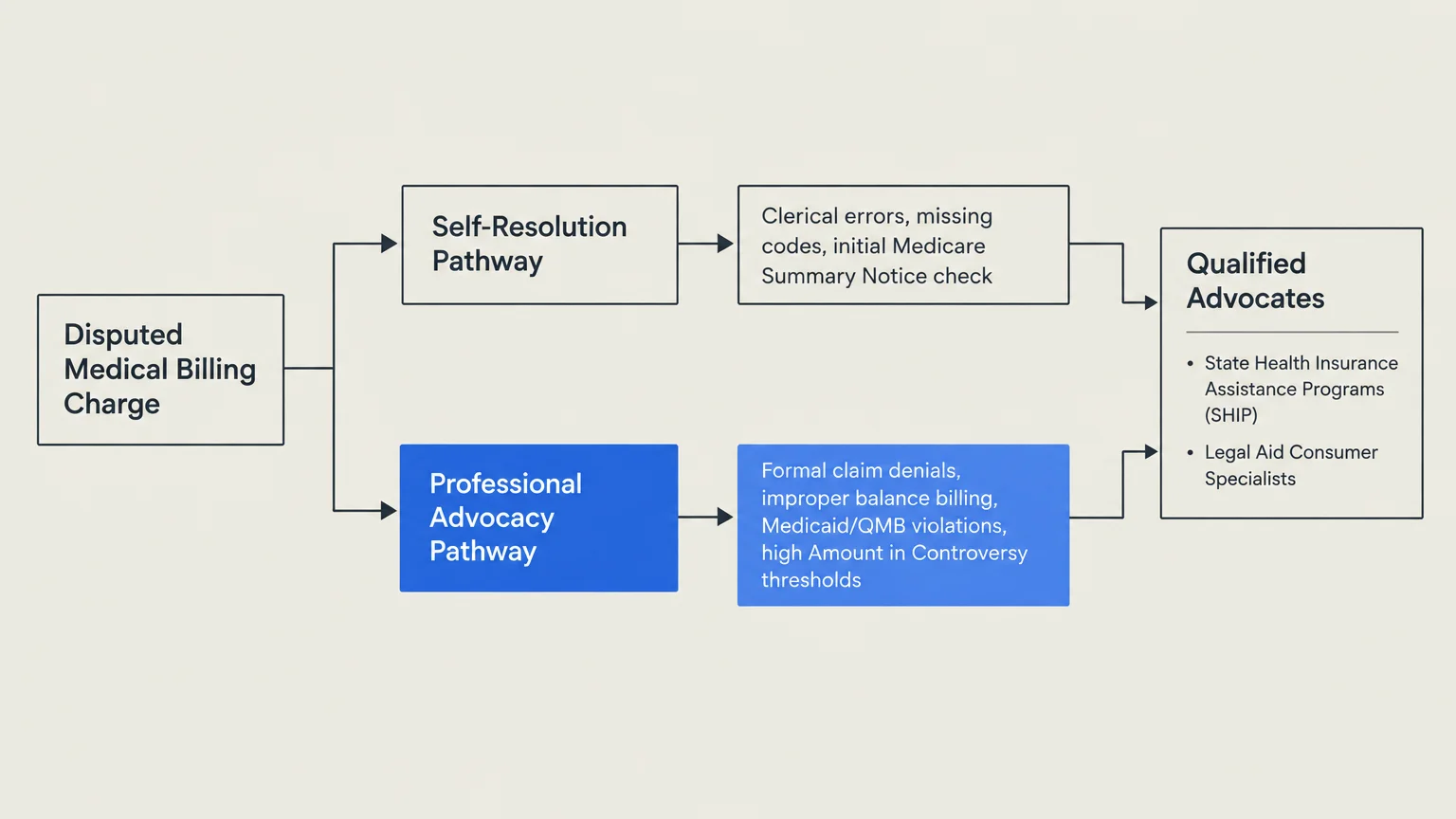
While many medicare billing errors resolve through routine phone calls, complex disputes require specialized guidance. Knowing when to escalate your case saves time and prevents unlawful collections.
Seek advice from a qualified elder law attorney if an appeal reaches Level 3 or higher. An Administrative Law Judge hearing involves legal briefs, medical cross-examinations, and strict rules of evidence.
You should also consult an attorney or local legal aid organization if debt collectors harass you for illegal balance bills. Improper billing of QMB beneficiaries violates federal statutes, and legal professionals can stop collections immediately.
Your State Health Insurance Assistance Program provides free, unbiased counseling from trained community volunteers. These counselors assist with navigating Medicare Advantage denials, Part D payment plans, and initial appeal filings.
For official information, consult government resources like USA.gov, the Consumer Financial Protection Bureau (CFPB), and the Federal Trade Commission (FTC).
For tax-related topics, refer to the IRS. For information on Social Security, visit the Social Security Administration.
Frequently Asked Questions (FAQs)
What is the difference between an Explanation of Benefits and a real bill?
An Explanation of Benefits is an informational statement detailing how your insurer processed your claim. It shows the doctor’s charges, plan discounts, and what portion you might owe.
It is not a bill. You should never send payment directly to your insurance company based on an explanation of benefits notice.
Wait until you receive an itemized invoice from your medical provider. Compare the provider’s bill to your explanation of benefits to ensure the numbers match perfectly before issuing payment.
Can a doctor send me to collections while I am appealing a Medicare claim?
Healthcare providers should pause active debt collection efforts while a timely, legitimate Medicare appeal is pending. However, administrative communication failures occasionally lead to premature collection notices.
Send written notice to both the billing department and the collection agency immediately. Include copies of your filed appeal paperwork and request a formal hold on collection actions.
Federal debt collection laws give you rights to dispute unverified medical debts. A collector must halt collection activity until they verify the underlying validity of the disputed debt.
What should I do if a hospital refuses to give me a Change of Status Notice?
Hospitals must deliver the Medicare Change of Status Notice at least four hours before discharge when reclassifying patients to observation. If staff fail to provide it, demand to speak with a patient advocate.
Contact your regional Beneficiary and Family Centered Care Quality Improvement Organization right away. These independent organizations handle urgent complaints regarding discharge notices and observation reclassifications.
Filing an expedited complaint creates a formal administrative record. This step helps protect your right to appeal rehabilitation facility coverage after leaving the hospital.
How does the $35 insulin cap work if my pharmacy tries to charge more?
All Medicare Part D drug plans must cap covered insulin products at $35 per monthly supply. This rule applies even if you have not met your annual prescription deductible.
If a pharmacist charges more, ask them to check the Medicare Part D billing rules. Ensure they are processing the medication under your Part D coverage rather than standard retail rates.
If the pharmacy cannot fix the issue, contact your Part D insurer from the pharmacy counter. You have the right to request an expedited coverage redetermination within 72 hours.
Can a doctor charge whatever they want if they opt out of Medicare entirely?
Doctors who formally opt out of Medicare operate outside the federal payment system entirely. They do not accept Medicare payments and can set their own private fee schedules.
However, an opted-out doctor must have you sign a formal private contract before rendering any services. This contract states that neither you nor the doctor can bill Medicare for reimbursement.
If an opted-out doctor treats you without having you sign this mandatory contract beforehand, you are not bound by their private fees. You can report non-compliant providers to Medicare regional officials.
Disclaimer: The information provided on this website does not, and is not intended to, constitute legal advice; instead, all information, content, and materials available on this site are for general informational purposes only. Information on this website may not constitute the most up-to-date legal or other information. Readers of this website should contact their attorney to obtain advice with respect to any particular legal matter.