
Documenting your final wishes protects your loved ones from emotional confusion and unnecessary financial strain during a painful time. Clear instructions ensure that doctors, courts, and relatives honor your medical choices and personal values without delay.
Taking action guarantees that your voice guides every critical healthcare decision, property transfer, and memorial service. You eliminate bitter family disputes by replacing stressful guesswork with legally recognized documentation.
These eleven practical strategies empower you to take complete control of your legacy. You will discover exactly how to establish enforceable plans that protect your estate, finances, and dignity.
Key Concepts and Terminology Explained
Navigating end of life planning requires understanding a few core legal instruments. Clarifying these terms helps you choose the right tools for your personal situation.
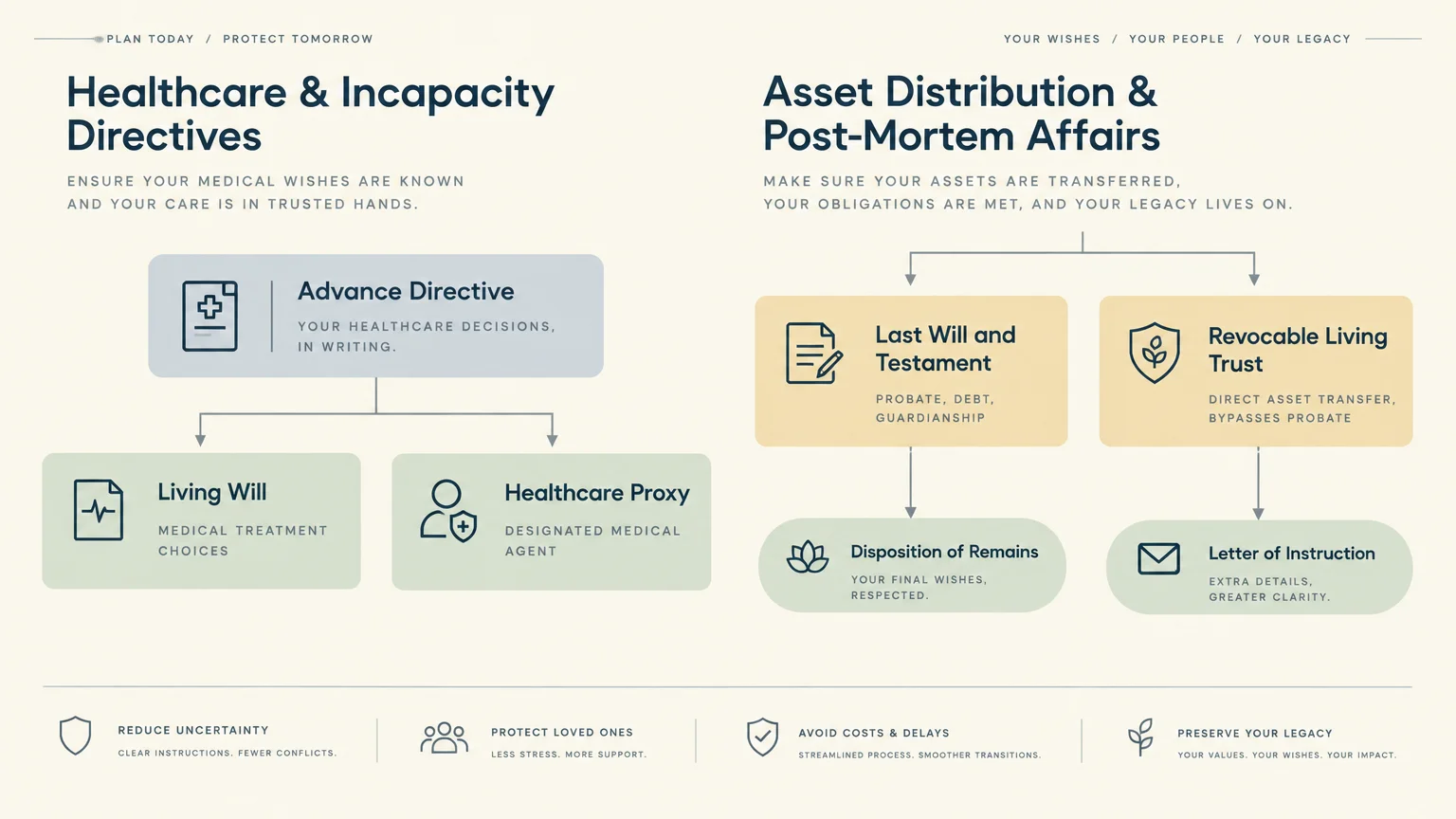
Advance Directive: A legal document that outlines your preferences for medical care if you become incapacitated. It typically combines a living will and a medical power of attorney.
Living Will: A written statement specifying the medical treatments you want or reject if you face a terminal illness or permanent unconsciousness. It directly guides clinical decisions regarding life support.
Healthcare Proxy: The trusted person you designate to make medical choices on your behalf when you cannot speak for yourself. This individual is also called a healthcare agent or surrogate.
Last Will and Testament: A formal legal document that dictates how the probate court distributes your personal assets after death. It also appoints an executor to manage the estate and nominates guardians for minor children.
Revocable Living Trust: A legal entity you create to hold ownership of your property during your lifetime. Assets held in trust pass directly to designated heirs without going through probate court.
Disposition of Remains: The legal determination of how your body will be handled after death. Options include earth burial, flame cremation, or emerging green alternatives.
Letter of Instruction: An informal, non-binding document providing practical details to your family. It covers account passwords, location of important papers, and personal memorial requests.

A Practical Guide to 11 Ways to Make Sure Your Final Wishes Are Followed
Proactive estate planning requires structured, enforceable action. Follow these eleven practical steps to ensure your intentions remain legally protected and clearly communicated.
1. Draft a Legally Enforceable Will
A formal will serves as the bedrock of traditional asset distribution. Without one, state intestacy laws dictate who receives your property regardless of your private intentions.
According to Caring.com’s 2025 Wills and Estate Planning Study, only 24% of American adults have a will. Similarly, Trust & Will’s 2026 Estate Planning Report found that 26% of Americans maintain a valid will.
That means roughly 76% of adults leave their affairs entirely to state defaults. Over 40% of adults without a will admit they simply have not gotten around to it.
Another 40% mistakenly believe they do not own enough assets to justify legal planning. However, every adult benefits from naming an executor and designating property recipients.
Your will names a dependable executor to manage your affairs. This person pays final debts, closes accounts, and distributes assets according to your written instructions.
If you have minor children, your will represents the only legal mechanism to nominate their guardian. Failing to name a guardian forces a family court judge to make that decision.
To ensure legal validity, sign your will in front of two adult, disinterested witnesses. Adding a notarized self-proving affidavit accelerates the court probate process significantly.
2. Establish an Advance Directive
Medical emergencies often leave individuals unable to communicate their care choices. An advance directive ensures medical providers follow your personal values regarding end-of-life care.
Use your living will to state explicit instructions about cardiopulmonary resuscitation (CPR) and mechanical ventilation. Clarify whether you accept or refuse artificial tube feeding and hydration.
Detail your preferences regarding diagnostic tests, invasive surgeries, and kidney dialysis during end-stage conditions. Clear statements prevent doctors from initiating aggressive interventions you never wanted.
Address your wishes for pain management and palliative comfort care. You can specify that physicians administer sufficient pain relief even if it induces sedation.
State your preferences regarding organ and tissue donation directly within your directive. This removes an agonizing choice from grieving family members at your bedside.
Store your directive where physicians can access it instantly during a crisis. Provide certified copies to your primary care physician, local hospital network, and appointed proxy.
3. Appoint a Dedicated Healthcare Proxy
A living will cannot predict every medical scenario that may arise in an emergency room. You must appoint a healthcare proxy to interpret your wishes when unexpected choices emerge.
Choose an agent who remains calm under intense emotional pressure. This person must possess the backbone to enforce your directives against disagreeing family members or hesitant medical personnel.
Geographic proximity matters when selecting your healthcare representative. An agent who lives nearby can reach the hospital quickly to confer directly with treating physicians.
Always name at least one alternate healthcare proxy in your legal paperwork. If your primary agent is unavailable or incapacitated, the alternate steps in without judicial delay.
Discuss your values with your chosen proxy in detail before signing the paperwork. They cannot defend your preferences if they do not understand your core beliefs.
4. Execute a Durable Financial Power of Attorney
End of life planning involves managing everyday financial obligations prior to your passing. If you suffer cognitive decline or medical incapacity, your household bills still require payment.
A durable financial power of attorney authorizes a trusted agent to access accounts and manage property. The word “durable” ensures the agent’s legal authority continues if you become incapacitated.
Without this document, your family must petition a court for conservatorship or guardianship to manage your finances. That legal process consumes thousands of dollars and creates severe delays.
Your financial agent can pay medical bills, manage mortgages, and interact with the government. They can also file your annual income tax returns and cancel subscription services.
Define the scope of power carefully to prevent potential financial abuse. Specify whether the authority takes effect immediately or springs into action only after formal medical certification.
5. Create and Fund a Revocable Living Trust
A will must pass through probate, which creates public court records and delays asset distribution. A revocable living trust transfers property privately and immediately upon your death.
You maintain complete control over trust property while you remain alive and competent. You can amend the trust terms, buy or sell assets, or dissolve the trust entirely.
When you pass away, your designated successor trustee steps in without probate court involvement. They transfer assets directly to your named beneficiaries according to your precise rules.
Creating the trust document is only the first phase of this legal strategy. You must also fund the trust by re-titling assets into the name of the trust.
Transfer real estate deeds, brokerage accounts, and valuable personal property into the trust. Assets left outside the trust may still trigger probate proceedings.
6. Align Beneficiary Designations
Many financial assets pass to heirs through contractual beneficiary forms rather than through your will. These contractual forms legally override any conflicting instructions written inside your will.
If your will leaves everything to your children, but an old retirement account lists your ex-spouse, the ex-spouse receives the money. Financial institutions follow the signed beneficiary form every time.
Review beneficiary designations on employer retirement plans, individual retirement accounts (IRAs), and life insurance policies. Check checking, savings, and investment accounts for Payable-on-Death (POD) or Transfer-on-Death (TOD) provisions.
Always list primary beneficiaries and contingent beneficiaries for every individual account. Contingent beneficiaries inherit the assets if your primary choice predeceases you.
Review these designations following major life events like marriages, divorces, births, or deaths. Keeping beneficiary forms aligned prevents accidental disinheritance of people you love.
For wealth transfer context, federal tax law provides generous thresholds. The IRS federal estate and lifetime gift tax exemption for 2026 is $15 million per individual or $30 million for married couples.
Additionally, the federal annual gift tax exclusion for 2026 stands at $19,000 per recipient. Aligning your beneficiary designations works hand-in-hand with these statutory tax allowances.
7. Document Specific Funeral and Memorial Wishes
Leaving funeral arrangements to grieving relatives creates intense stress and invites emotional overspending. Documenting your funeral planning choices spares your family from unnecessary burdens.
Clarify whether you prefer earth burial or cremation. National Funeral Directors Association (NFDA) data shows the U.S. cremation rate reached 63.4% in 2025, compared to 31.6% for burial.
By 2045, the NFDA projects the national cremation rate will climb to 82.3%. Understanding these options helps you align your arrangements with modern trends and personal values.
Funeral expenses represent a significant financial commitment. The NFDA benchmark General Price List Study reports the national median cost of a traditional funeral with viewing and burial is $8,300.
When you include a required burial vault, that median traditional burial cost rises to $9,995. This figure excludes the purchase of cemetery plots, grave opening fees, and headstones.
For cremation with a formal viewing and service, the national median cost is $6,280. Direct cremation without viewing or ceremony ranges from $1,000 to $3,000, with a 2026 sample median starting price of $1,995.
Despite these significant costs, only 19.4% of consumers pre-plan and prepay their funeral arrangements. Taking this step relieves your family of an immediate financial obligation.
Interest in environmentally conscious alternatives continues to expand rapidly across the country. NFDA surveys reveal that 61.4% of consumers express interest in exploring green or eco-friendly funeral options.
Natural organic reduction, commonly known as human composting, represents an increasingly popular eco-friendly alternative. This gentle process converts human remains into nutrient-rich soil over several weeks.
Fourteen states have legalized natural organic reduction: Washington, Colorado, Oregon, Vermont, California (effective January 1, 2027), New York, Nevada, Arizona, Maryland, Delaware, Minnesota, Maine, Georgia, and New Jersey.
8. Designate an Agent for Disposition of Remains
Most states enforce a rigid legal hierarchy determining who controls your remains if you leave no instructions. Typically, the right passes to a surviving spouse, followed by adult children, then parents, then siblings.
If your adult children disagree on burial versus cremation, funeral homes will halt services until courts intervene. You can prevent this paralysis by executing an Appointment of Agent for Disposition.
This simple document grants one designated person the exclusive legal authority to direct your body’s final arrangements. It overrides default state hierarchies and eliminates family disputes.
Federal regulations provide powerful protections when your representative works with funeral providers. The Federal Trade Commission enforces the Funeral Rule (16 CFR Part 453) to guarantee consumer rights.
Under this federal law, funeral homes must give you an itemized General Price List (GPL) in person. They must also provide accurate pricing over the telephone whenever requested.
Furthermore, funeral homes cannot charge handling fees if you buy a casket or urn from an outside vendor. While California requires online pricing links, federal online disclosure mandates remain pending review in 2026.
9. Write a Detailed Letter of Instruction
A letter of instruction acts as an informal, personal guide for your executor and immediate family. While not legally binding like a will, it provides invaluable practical clarity.
Detail the location of physical assets, hidden keys, vehicle titles, and safety deposit boxes. List real estate deeds, insurance policy numbers, and primary banking relationships.
Include instructions for your pets, specifying who should care for them and their dietary or medical requirements. Pet provisions prevent beloved companion animals from ending up in crowded shelters.
You can also express preferences for memorial music, readings, or charitable donation requests in lieu of flowers. These personal touches offer deep comfort to those organizing your services.
Never lock this letter inside a bank safe deposit box that seals upon your death. Keep it in a secure fireproof home safe and share copies with your personal representative.
10. Secure Your Digital Estate and Passwords
Modern lives leave substantial digital footprints that require thoughtful management after death. Failing to plan for digital assets locks families out of vital records, photographs, and online accounts.
Compile an encrypted inventory of your digital presence, including email accounts, online banking, and cloud photo storage. Include social media profiles, domain registrations, and recurring subscription services.
Most states have enacted the Revised Uniform Fiduciary Access to Digital Assets Act (RUFADAA). This legislation allows fiduciaries to access digital property only if the account holder explicitly granted permission.
Take advantage of online legacy tools provided by major technology platforms. Apple lets you appoint Legacy Contacts, while Google features an Inactive Account Manager to share data automatically.
Use a reputable password manager and store the emergency master access key with your legal paperwork. Never write account passwords directly inside a public will, as wills become public records.
11. Conduct an Open Family Conversation
Legal documents provide the structure, but open conversation ensures understanding and acceptance among relatives. Transparent discussions eliminate shocking surprises that frequently spark emotional estate battles.
Research from Vanilla indicates that 35% of U.S. adults have experienced family conflict due to the lack of an estate plan. Holding an open meeting directly mitigates this destructive risk.
Gather your family members together or schedule a dedicated video conference to outline your plans. Explain the reasoning behind your appointments for executor, healthcare proxy, and financial agent.
Clarify your decisions regarding asset distribution and heirlooms with sentimental value. Giving family members an opportunity to ask questions now prevents resentment later.
Frame the meeting around love and preparedness rather than decline and mortality. Remind your family that your planning provides them with clarity and peace of mind during grief.

Common Mistakes and How to Avoid Them
Even well-intentioned individuals make legal and logistical errors when organizing their final wishes. Avoiding these five common pitfalls keeps your planning functional and secure.
- Storing Documents in an Inaccessible Safe Deposit Box: Many banks seal safe deposit boxes immediately upon the owner’s death until probate opens. Store original healthcare directives and letters of instruction in an accessible, fireproof home safe instead.
- Placing Funeral Instructions Solely in Your Will: Families often locate and read a will weeks after the funeral concludes. Record your funeral preferences in a separate disposition directive and give copies directly to your agent.
- Ignoring Beneficiary Designation Updates: Forgetting to update retirement and life insurance forms leads to unintended payouts to former spouses. Review all financial beneficiary designations every two to three years or following life changes.
- Failing to Fund Your Revocable Trust: Signing trust paperwork without transferring asset titles renders the trust ineffective for probate avoidance. Ensure real estate deeds, bank accounts, and brokerage holdings reflect your trust’s formal legal name.
- Neglecting to Name Alternate Fiduciaries: If your primary executor or proxy passes away or falls ill, your plan stalls. Always name at least one secondary successor for every fiduciary role you assign.

When to Consult a Professional
Self-help forms and online templates handle simple situations, but many family circumstances require professional expertise. Qualified professionals ensure your paperwork complies with nuanced state statutes.
Consult an experienced estate planning attorney if you own a blended family, business interests, or real estate in multiple states. Legal counsel is essential if you plan to disinherit a statutory heir or care for a child with special needs.
Engage a Certified Public Accountant (CPA) or financial advisor to navigate complex tax rules and asset distribution strategies. Even if your assets fall below federal estate tax limits, state-level inheritance taxes may apply.
Reach out to licensed funeral directors to review your burial or cremation preferences under local regulations. Funeral professionals can explain itemized pricing requirements mandated under the FTC Funeral Rule.
Speak with healthcare providers or palliative care teams to understand specific medical terminology in advance directives. Clinical guidance ensures your written medical choices accurately reflect your philosophical preferences.
Frequently Asked Questions (FAQs)
Can my family override my advance directive or living will?
In most jurisdictions, healthcare providers must follow a legally executed advance directive regardless of family objections. However, if your documents are ambiguous or contradictory, doctors often defer to grieving family members to avoid legal liability.
What happens if I pass away without an estate plan or will?
If you die without a will, the state probate court distributes your property according to statutory intestacy laws. The court appoints an administrator to oversee your estate, and your assets pass strictly according to rigid legal bloodlines.
How often should I review and update my end-of-life documents?
Review your estate planning documents every three to five years to ensure they match current laws. Conduct an immediate review following significant life events, such as marriage, divorce, relocation to a new state, or the birth of a child.
Is a handwritten letter detailing funeral requests legally binding?
A handwritten letter is generally treated as an expression of personal preference rather than an enforceable legal mandate. To make your funeral preferences binding, execute a state-recognized Appointment of Agent for Disposition or a formal contractual pre-need plan.
How does the FTC Funeral Rule protect consumers?
The FTC Funeral Rule prohibits funeral providers from forcing you to buy bundled packages with items you do not want. It mandates that funeral homes provide itemized pricing lists, provide quotes over the phone, and accept third-party caskets without extra fees.
For official information, consult government resources like USA.gov, the Consumer Financial Protection Bureau (CFPB), and the Federal Trade Commission (FTC).
For tax-related topics, refer to the IRS. For information on Social Security, visit the Social Security Administration.
Disclaimer: The information provided on this website does not, and is not intended to, constitute legal advice; instead, all information, content, and materials available on this site are for general informational purposes only. Information on this website may not constitute the most up-to-date legal or other information. Readers of this website should contact their attorney to obtain advice with respect to any particular legal matter.