Writing your final wishes on a simple sheet of paper might feel fast and personal, but it often leaves your loved ones facing painful legal battles. A handwritten will frequently lacks core legal formalities, creating procedural disputes that can tie up your estate for years.
Probate courts across the country routinely dismiss unwitnessed documents or interpret ambiguous wording against the author’s original intentions. You risk distributing your hard-earned assets to unintended recipients if the judge deems your personal instructions legally invalid.
Understanding how handwritten wills operate helps you protect your family from devastating financial and emotional friction. Taking proactive estate planning steps today ensures that your true voice directs your legacy tomorrow.
Key Concepts and Terminology Explained
Navigating probate law requires an understanding of basic legal concepts. Clearing away confusing jargon empowers you to make informed decisions for your estate.
What Is a Holographic Will?
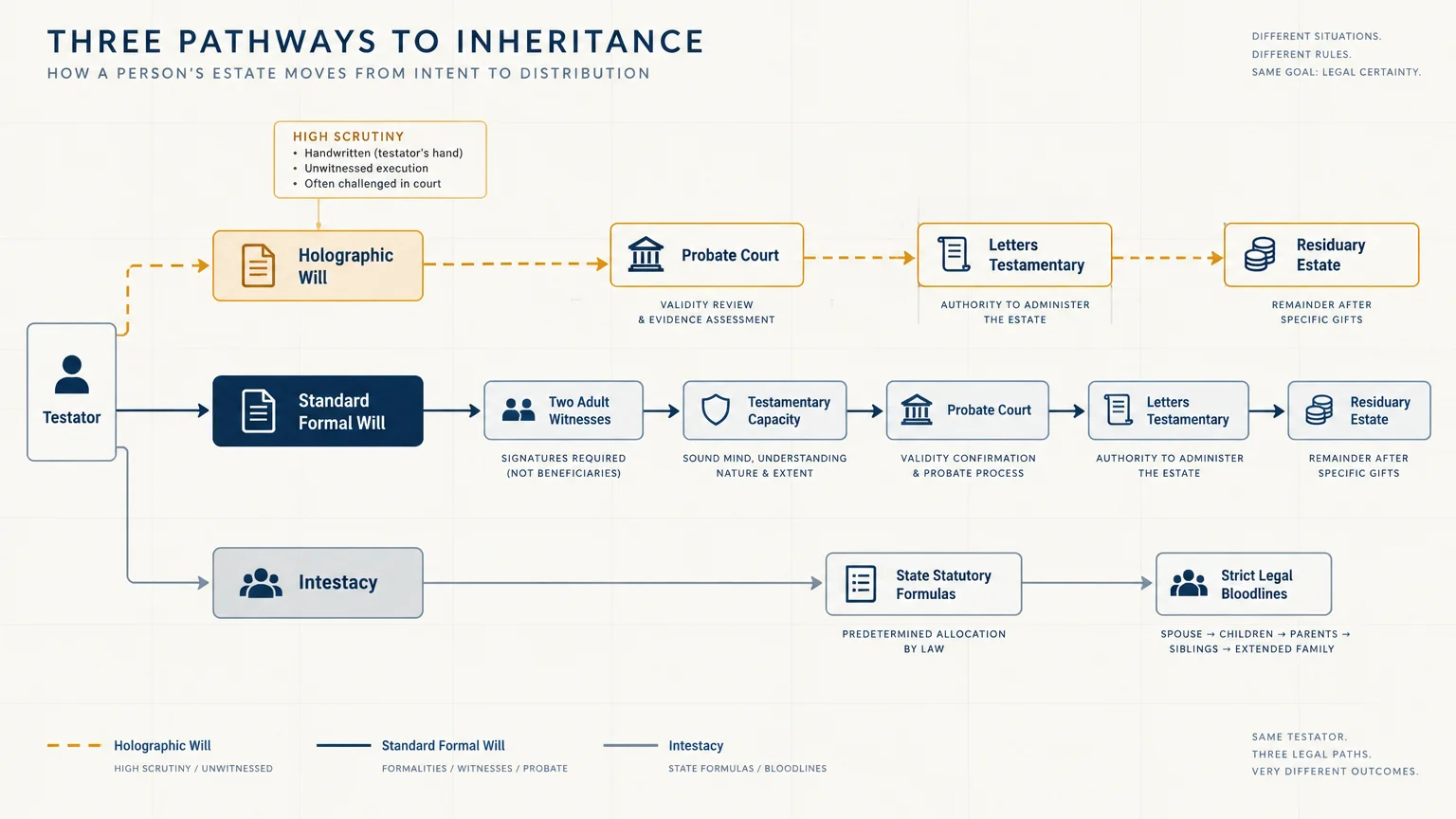
In legal terms, a handwritten will is formally called a holographic will. This document is written entirely or primarily in your own handwriting rather than typed and formally witnessed.
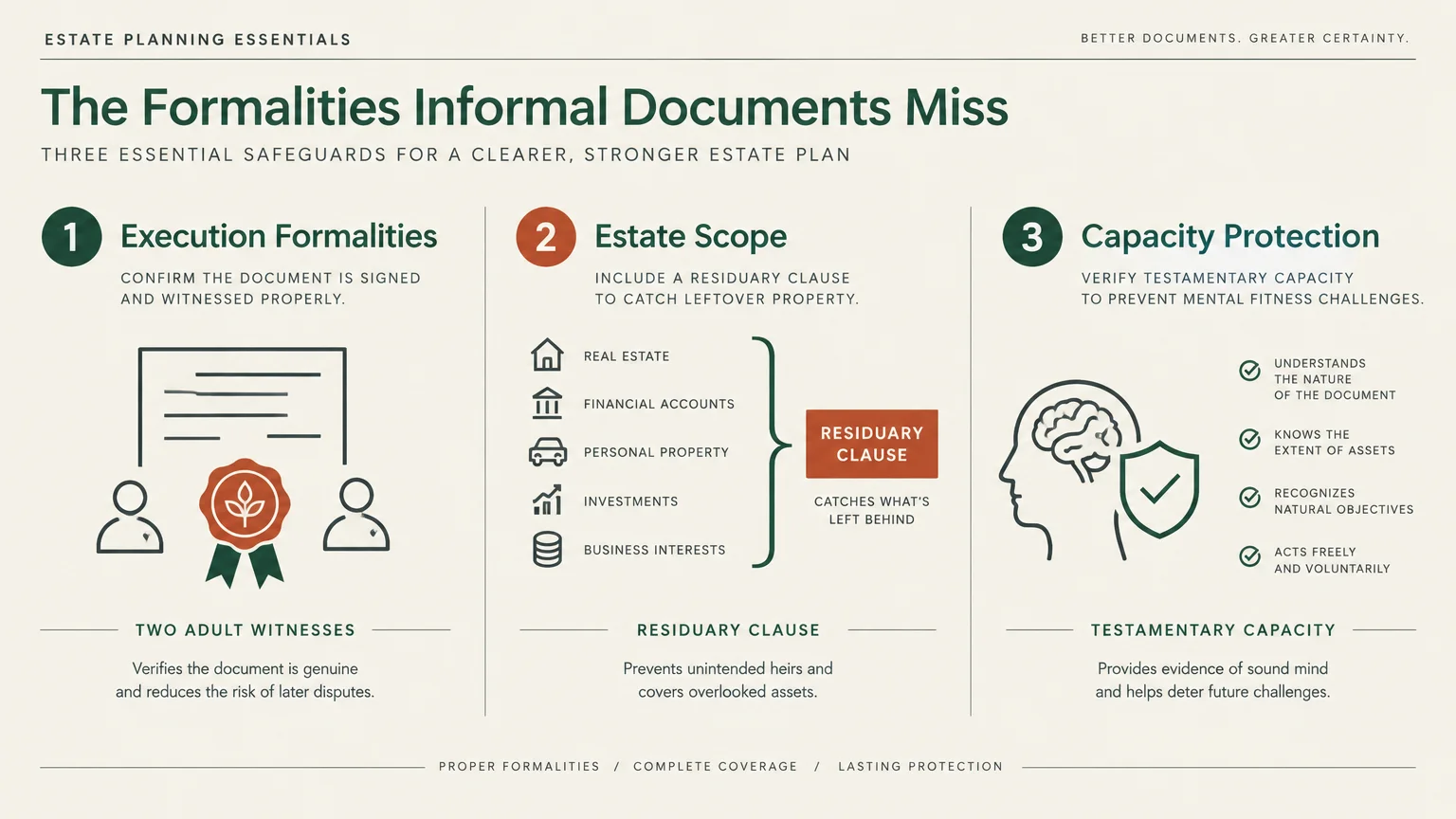
Most standard wills require two adult witnesses who watch you sign the paper and then sign it themselves. A holographic will generally lacks these formal attestation procedures, which immediately raises legal scrutiny in court.
The Testator
The testator is the legal term for you, the person who writes and executes a will. To create a valid document, you must possess what the law calls testamentary capacity.
Testamentary capacity means you understand the full nature of your assets and realize who would naturally inherit your property. If your mental state is questioned later, proving capacity without witnesses becomes an uphill battle.
Probate and Letters Testamentary
Probate refers to the court-supervised legal proceeding that validates a will, pays off debts, and distributes remaining property. Every will must pass through probate before beneficiaries can receive their inheritances.
During this process, the probate court grants legal authority to a personal representative through letters testamentary. Without this official court document, banks and title companies will refuse to transfer your financial accounts or real estate.
Intestacy: When the Court Decides
Intestacy occurs when an individual dies without a valid will in place. If a probate judge throws out your handwritten document, your estate enters partial or total intestacy.
When intestacy takes over, state statutory formulas dictate who receives your money, vehicle, and home. The court will follow strict legal bloodlines rather than honoring your personal, unproven wishes.
The Residuary Estate
Your residuary estate consists of everything you own that is not explicitly left to a specific person. It functions as the legal safety net for your entire property portfolio.
A comprehensive will always includes a residuary clause to capture unexpected funds or overlooked belongings. Handwritten documents routinely omit this clause, sending leftover property into probate chaos.

A Practical Guide to 7 Reasons a Handwritten Will Can Cause Problems
Drafting a informal document on a notepad might seem like an easy way to save time and money. However, handwritten records invite significant legal challenges that can overwhelm your surviving relatives.
Here are the seven primary problems with handwritten wills that you must consider before attempting to write your own document.
1. Geographic Invalidation Across State Lines
One of the most dangerous problems with handwritten wills is that state laws vary drastically across the country. You might write a note that meets legal standards in one state, only to have it rejected after you relocate.
Currently, only 27 U.S. states generally recognize holographic wills as legally valid estate documents. In those jurisdictions, state codes typically require the signature and material provisions to appear entirely in your handwriting.
Major states completely reject unwitnessed holographic wills executed within their borders, including Florida, Illinois, Georgia, and Ohio. If you pass away as a resident of these states with an unwitnessed note, the probate court will declare it invalid immediately.
Other states enforce strict military exceptions rather than broad civilian rules. For example, New York and Maryland only accept holographic documents from active-duty military service members in combat zones or mariners at sea.
These emergency military provisions carry statutory expiration dates as well. In most cases, the handwritten document becomes completely invalid just one year after the individual returns home or separates from military duty.
If you retire to a sunbelt state or move closer to your grandchildren, your existing handwritten document could lose its legal authority overnight. Moving across state lines demands a thorough review of your estate planning documents to avoid accidental invalidation.
2. Burdensome Handwriting Proof in Probate Court
When you present a standard, attorney-drafted will to a judge, a formal self-proving affidavit allows immediate entry into probate. In stark contrast, a holographic will forces your family to legally prove that you wrote every single word yourself.
State probate courts apply rigid evidentiary standards before accepting handwritten documents. Among the states that recognize these wills, 6 states demand that the entire document—every single sentence, heading, and date—must be in your handwriting.
Another 13 states follow the Uniform Probate Code standard, which requires only the material provisions and signature to be in your script. However, defining what constitutes a material provision often triggers contentious legal debates among competing heirs.
Some states place extraordinary procedural burdens on your family during probate. In Arkansas, for example, state law requires 3 disinterested witnesses to testify under oath in probate court to authenticate your unique handwriting.
Finding three independent people who know your handwriting well—and who do not stand to inherit any money—can prove nearly impossible. If your family cannot produce these qualified witnesses, the judge must toss the document aside.
Your estate may have to spend thousands of dollars hiring a professional forensic document examiner. This costly expert must examine old letters, checks, and journals just to convince a skeptical judge that you penned the page.
3. Vague Language and Unintended Disinheritances
Laypeople rarely understand how probate judges define everyday words under established statutory law. Casual phrases that sound clear around the kitchen table often create paralyzing legal ambiguities in a courtroom.
When you write a will yourself, you might leave your “belongings” or “personal effects” to a favorite sibling. In the legal world, those specific terms generally refer only to tangible goods like furniture, clothing, and small household items.
A judge interpreting that language might conclude you never intended to pass your bank accounts, stocks, or real estate to that sibling. Without clear legal terminology, your actual financial wealth might pass to an estranged relative through state intestacy laws.
Handwritten wills also suffer from what lawyers call precatory language. This happens when you use polite, non-binding words like “I hope,” “I wish,” or “my desire is” instead of mandatory legal commands.
If you write, “I wish for my daughter to share the house with her brother,” a judge will view that sentence as an unenforceable suggestion. Your daughter would have no legal obligation to honor that request, potentially leaving her brother without a home.
Professional estate planning relies on precise legal phrasing to eliminate all doubt regarding your intentions. Ambiguity forces judges to guess what you meant, and their statutory interpretations frequently contradict your true wishes.
4. Missing Administrative Clauses and Residuary Gaps
A comprehensive estate plan contains essential administrative machinery that allows your executor to manage your affairs efficiently. Handwritten documents almost never include these vital procedural clauses.
Most individuals drafting a note at home forget to name an executor altogether. When you fail to nominate a representative, the probate judge chooses an administrator based entirely on statutory priorities.
This court-appointed stranger might be an argumentative relative whom you never would have trusted with your financial affairs. Furthermore, formal wills contain clauses that waive the requirement for an executor to post an expensive surety bond.
Without an explicit bond waiver, your personal representative must purchase a fiduciary bond from an insurance company using estate funds. This unnecessary expense drains hundreds or thousands of dollars directly from your children’s inheritance.
Even more critical is the frequent omission of a formal residuary clause. If you list three specific items for three specific people, what happens to your savings account, tax refunds, or unexpected insurance proceeds?
Without a residuary clause, every asset you forgot to mention by name must be processed under state intestacy rules. Your estate ends up trapped in a hybrid nightmare where half your assets follow your note and half follow state codes.
5. Lost Pages and Competing Handwritten Drafts
Formal wills are signed at a single sitting, stapled with permanent bindings, and stored safely in fireproof vaults or corporate archives. Handwritten notes, however, are easily lost, misplaced, coffee-stained, or accidentally thrown away.
People who handwrite their wills often write multiple versions over the years as their feelings change. They might scribble an update on a scrap of paper without formally destroying or revoking their previous handwritten notes.
When an individual passes away, relatives often uncover different, contradictory notes hidden in closets, desk drawers, or books. This scenario guarantees immediate conflict as competing family members produce different papers that favor their individual interests.
A famous real-world example occurred when legendary singer Aretha Franklin passed away in August 2018. Her family initially believed she had died without leaving any valid testamentary documents behind.
Months later, family members uncovered multiple handwritten wills throughout her home, including a 2014 notebook tucked under a couch cushion. That discovery triggered an agonizing 5-year legal war between her sons over document validity and scribbled marginal notes.
A Michigan jury finally ruled the 2014 sofa document valid in July 2023, after five years of public acrimony and massive legal fees. An informal document under a cushion caused half a decade of turmoil that a formal will would have prevented entirely.
6. Susceptibility to Undue Influence and Capacity Claims
When an attorney oversees the signing of a standard will, neutral legal professionals observe your mental alertness firsthand. They document your testamentary capacity and verify that no manipulative relative is coercing your choices.
A handwritten will provides zero independent verification of your mental state at the exact moment of execution. You sit alone with a pen, leaving no objective witnesses who can testify that you were lucid and acting freely.
This lack of oversight opens the courtroom door wide for disgruntled heirs to allege undue influence. If a caregiver or one particular child assisted you, other family members will quickly claim that person coerced you into writing the note.
Will contests involving handwritten papers routinely focus on cognitive decline, dementia, or heavy medications. In standard probate, the attorney’s contemporaneous file notes defeat these opportunistic challenges before they gain traction.
Without those professional safeguards, your surviving family faces prolonged legal depositions and contentious medical record reviews. Disproving a claim of undue influence without independent witnesses places an enormous evidentiary burden on your chosen heirs.
Even if your handwritten note represents your authentic wishes, your family must endure months of exhausting litigation to defend your mental soundess. The absence of neutral witnesses turns what should be a peaceful transition into a bitter legal brawl.
7. Disproportionate Legal Fees and Asset Depletion
Many people write their own wills because they want to avoid paying an attorney an upfront drafting fee. While you might save a few hundred dollars today, this short-term shortcut can cost your family their entire financial legacy.
Drafting a standard, legally bulletproof will through an attorney generally costs between $300 and $1,500. Reliable digital estate tools also offer formal, witnessed options for $0 to $200, making legitimate protection accessible to almost everyone.
Compare those modest drafting costs to the financial devastation caused by contested probate litigation. When family members dispute an ambiguous or unwitnessed handwritten document, they must hire specialized estate litigators.
Probate litigation attorneys charge between $200 and $600+ per hour to represent clients in contested estate cases. In other circumstances, attorneys take these disputes on contingency, claiming between 25% and 40% of the entire estate value.
A contested probate trial easily consumes tens of thousands of dollars in billable hours, court fees, and expert witness charges. These massive administrative expenses are paid directly out of your estate, drastically diminishing the funds meant for your loved ones.
Saving a modest legal fee today can cost your children a substantial portion of their inheritance tomorrow. Spending a small amount on professional guidance now provides irreplaceable insurance against ruinous courtroom battles later.
Common Mistakes and How to Avoid Them
Handwritten wills fail due to identifiable, recurring errors that you can easily prevent. Recognizing these estate planning mistakes protects your family from unintended probate traps.
Blending Handwriting with Typed Text
A catastrophic mistake occurs when someone types out their wishes on a computer, prints the document, and adds handwritten notes in the margins. Alternatively, people often purchase fill-in-the-blank store forms and write inside the blank spaces by hand.
In many jurisdictions, blending typed text with handwriting immediately destroys the document’s status as a holographic will. If the state requires 100% handwriting, any printed or typed text can automatically invalidate the entire page.
If you want a typed document, you must execute it with the formal attestation of two independent, signing witnesses. Never attempt to mix digital typing with informal handwritten modifications.
Failing to Formally Revoke Older Documents
Another major mistake involves writing a new handwritten document without explicitly revoking previous wills. Under state probate law, an older will remains partially valid if the newer document does not clearly cancel it.
To revoke a prior will properly, your new document must state clearly: “I hereby revoke all prior wills and codicils made by me.” Without this explicit clause, the court will attempt to merge both documents together.
Merging conflicting documents creates legal gridlock when old gifts contradict your newest wishes. A formal revocation clause wipes the slate clean and establishes unambiguous legal authority for your current directives.
Ignoring Non-Probate Beneficiary Designations
Many individuals mistakenly assume that a handwritten will overrides every asset they own. In reality, a will has zero legal authority over non-probate assets that carry contractual beneficiary designations.
Your life insurance policies, retirement accounts, and bank accounts with payable-on-death clauses pass directly to the named individual outside of probate. If your will says your daughter gets your savings, but your bank form names your ex-spouse, the bank must pay your ex-spouse.
You must coordinate your direct beneficiary designations with your overall estate plan. Reviewing your bank forms regularly ensures that your financial accounts align perfectly with the intentions expressed in your will.
Practical Steps for a Clean Estate Plan
You can safeguard your legacy by adopting a disciplined approach to your planning. Follow these concrete steps to keep your affairs organized and legally enforceable:
- Work with an attorney to draft a formally attested, typewritten will that complies with your state’s unique statutes.
- Ensure two independent, disinterested adults watch you sign the document and sign their names as witnesses.
- Attach a notarized self-proving affidavit to eliminate the need for witnesses to appear in court later.
- Update your primary and contingent beneficiary designations on all retirement, investment, and insurance accounts.
- Store your original signed documents in a secure, accessible location, and inform your personal representative where to find them.
- Review your estate planning documents every three to five years, or whenever you experience a major life event like marriage, divorce, or relocation.

When to Consult a Professional
Estate planning is rarely a simple one-size-fits-all exercise. While basic forms exist, navigating personal family dynamics and complex property structures demands qualified legal counsel.
Indicators You Need Professional Guidance Immediately
Certain life situations make handwriting a will an unacceptably high-risk gamble. You should consult an experienced estate planning attorney if your circumstances include any of the following factors:
- You own real estate in more than one state, which triggers complicated ancillary probate proceedings.
- You have children from a previous marriage and want to balance their interests with those of your current spouse.
- You own a privately held business or commercial partnerships that require succession planning.
- You have a child or dependent with special needs who relies on government benefits like Medicaid or Supplemental Security Income.
- You wish to disinherit a direct heir, which virtually guarantees a contentious court fight without professional drafting.
- Your total net worth approaches state or federal estate tax exemption thresholds.
How to Prepare for Your Legal Consultation
Meeting with an estate planning attorney does not have to be intimidating or overly time-consuming. You can save billable time and keep your legal costs down by preparing your financial documents in advance.
Create a comprehensive inventory of your assets, including real estate deeds, vehicle titles, bank accounts, and investment portfolios. Note how each asset is currently titled, whether in your sole name or joint tenancy.
Gather copies of your current beneficiary forms for life insurance policies, pensions, and individual retirement accounts. Having these documents organized allows your attorney to quickly identify gaps in your estate plan and craft an airtight strategy.
For official information, consult government resources like USA.gov, the Consumer Financial Protection Bureau (CFPB), and the Federal Trade Commission (FTC).
For tax-related topics, refer to the IRS. For information on Social Security, visit the Social Security Administration.
Disclaimer: The information provided on this website does not, and is not intended to, constitute legal advice; instead, all information, content, and materials available on this site are for general informational purposes only. Information on this website may not constitute the most up-to-date legal or other information. Readers of this website should contact their attorney to obtain advice with respect to any particular legal matter.
Frequently Asked Questions (FAQs)
Is a handwritten will legally binding in every state?
No, a handwritten will is not recognized across the entire country. Only 27 states accept unwitnessed holographic wills, while major states like Florida and Illinois reject them completely.
If you execute an unwitnessed handwritten document in a state that bans them, the probate court will declare it void. Your property will then pass according to rigid statutory intestacy formulas.
Can I write my will on a regular piece of notebook paper?
In states that recognize holographic wills, the physical writing surface generally does not determine legal validity. People have written valid wills on scrap paper, ledger sheets, and even walls in emergency situations.
However, loose sheets of paper invite intense legal skepticism regarding authenticity, missing pages, and physical tampering. A formal, bound document prepared by an attorney provides significantly greater legal protection.
Do handwritten wills need to be notarized to be valid?
Notarization alone does not transform an invalid handwritten document into a legally binding will. Most states evaluating a holographic will care primarily whether the material text and signature appear in your authentic handwriting.
While a notary verifies your identity, they do not verify testamentary capacity or substitute for required independent witnesses. Relying on a notary stamp instead of proper statutory witnesses remains a widespread estate planning mistake.
What happens if a probate judge rejects my handwritten will?
If the probate court declares your handwritten document invalid, your estate enters legal intestacy. The state government will distribute your assets according to statutory hierarchy rather than your personal desires.
This means your assets might go to estranged siblings or distant cousins instead of your close friends, favorite charities, or unmarried partner. Court rejection causes severe, permanent distortions of your true intentions.
How can my family prove my handwritten will is authentic?
Your family must present credible evidence to the probate judge verifying that you wrote the document yourself. Depending on state laws, they may need testimony from multiple disinterested acquaintances who recognize your personal handwriting.
In high-stakes disputes, your family must pay for professional forensic handwriting examiners to analyze your past personal writings. This evidentiary process takes months to complete and costs thousands of dollars in billable legal fees.
Does a handwritten will avoid probate court?
No, a handwritten will does not avoid probate under any circumstances. In fact, a handwritten will undergoes significantly more intense and prolonged probate proceedings than a standard, attorney-drafted document.
To bypass probate entirely, you must use non-probate legal vehicles such as a revocable living trust or transfer-on-death deeds. A handwritten will guarantees that your family must face the probate court system.
Can I make changes to my handwritten will by crossing out words?
Crossing out lines or writing notes in the margins of an existing document is extremely risky. In many states, unexecuted cross-outs trigger legal challenges regarding partial revocations and accidental cancellations.
Judges often struggle to determine whether marginal scribbles represent definitive decisions or merely tentative, passing thoughts. If you need to make changes, execute a completely new, witnessed document rather than defacing an existing paper.