
UnitedHealth Group sued the federal government on November 19, 2026, over lowered 2027 Medicare Advantage ratings. If you carry one of the many UnitedHealthcare Medicare plans, this dispute could directly affect your future premiums, copays, and extra benefits.
Your 2027 coverage will not change immediately because of these scores. Instead, the contested ratings govern how much federal bonus money your insurer receives for 2028—and how generous your benefits remain.
Understanding the UnitedHealth lawsuit helps you make smarter choices during active enrollment windows. Read on to see what this legal fight means for your wallet and how to protect your healthcare budget.
Key Concepts and Terminology Explained
Federal Medicare rules rely on specialized terms that can feel overwhelming at first glance. Breaking down the core vocabulary makes it much easier to follow Medicare Advantage news and see what matters for your household.
CMS Star Ratings
The Centers for Medicare & Medicaid Services (CMS) grades private Medicare plans every autumn on a scale from 1 to 5 stars. Scores move in half-star increments under federal regulations at 42 C.F.R. §§ 422.160–422.166.
Importantly, CMS assigns Star Ratings at the contract level rather than to individual plan names. That means every Medicare plan grouped inside the same federal contract receives the exact same overall score.
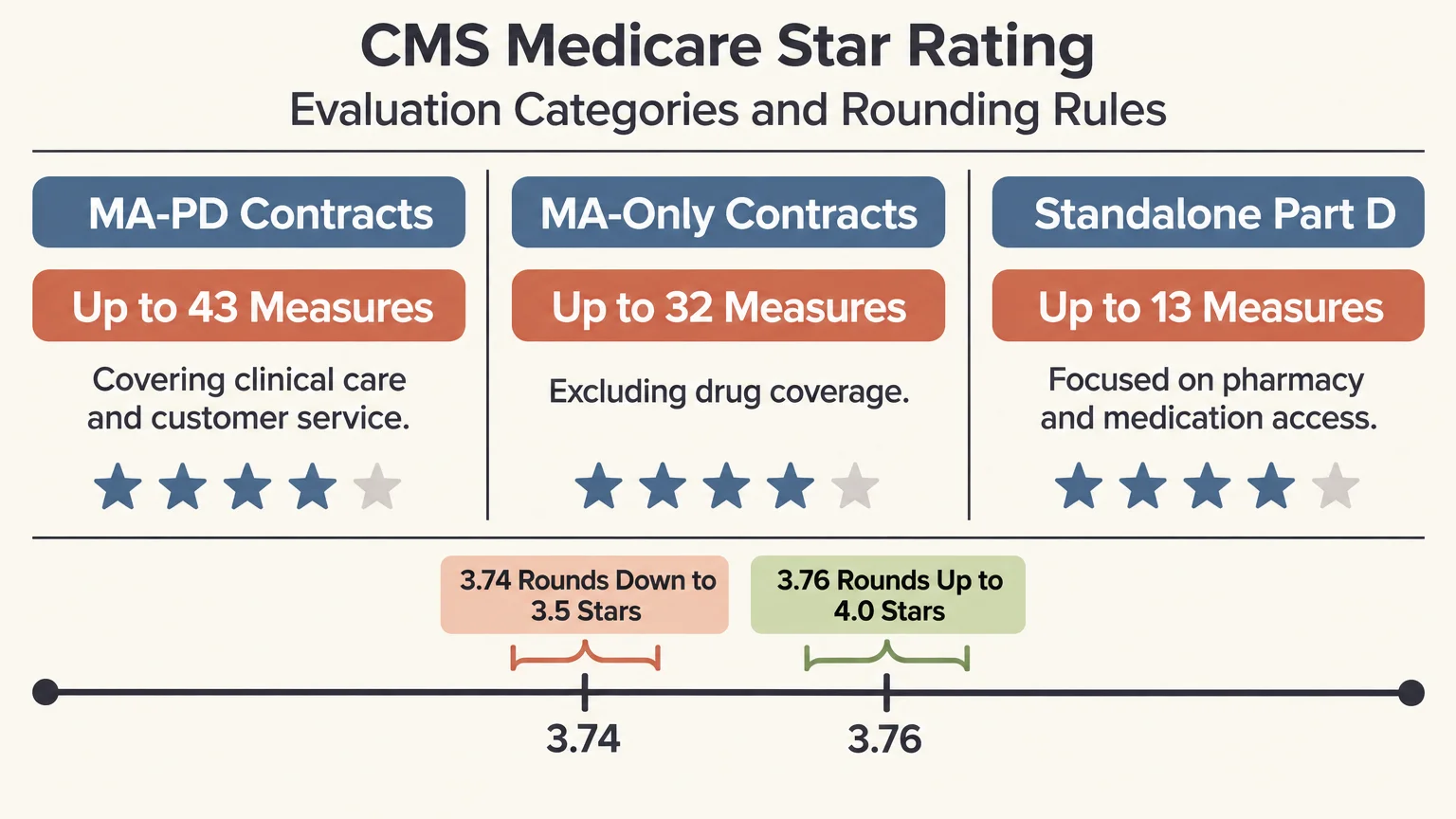
To calculate these 2027 CMS Star Ratings, regulators evaluate plans across dozens of clinical, customer service, and member satisfaction metrics:
- Medicare Advantage Prescription Drug (MA-PD) contracts: Graded on up to 43 quality and performance measures for 2027.
- Medicare Advantage-only contracts: Graded on up to 32 measures when drug coverage is excluded.
- Standalone Part D drug plans: Graded on up to 13 measures focused on medication access and safety.
CMS rounds each contract score to the nearest half-star. For example, a raw score of 3.74 rounds down to 3.5 stars, while a raw score of 3.76 rounds up to 4.0 stars.
Quality Bonus Payments and the Four-Star Cliff
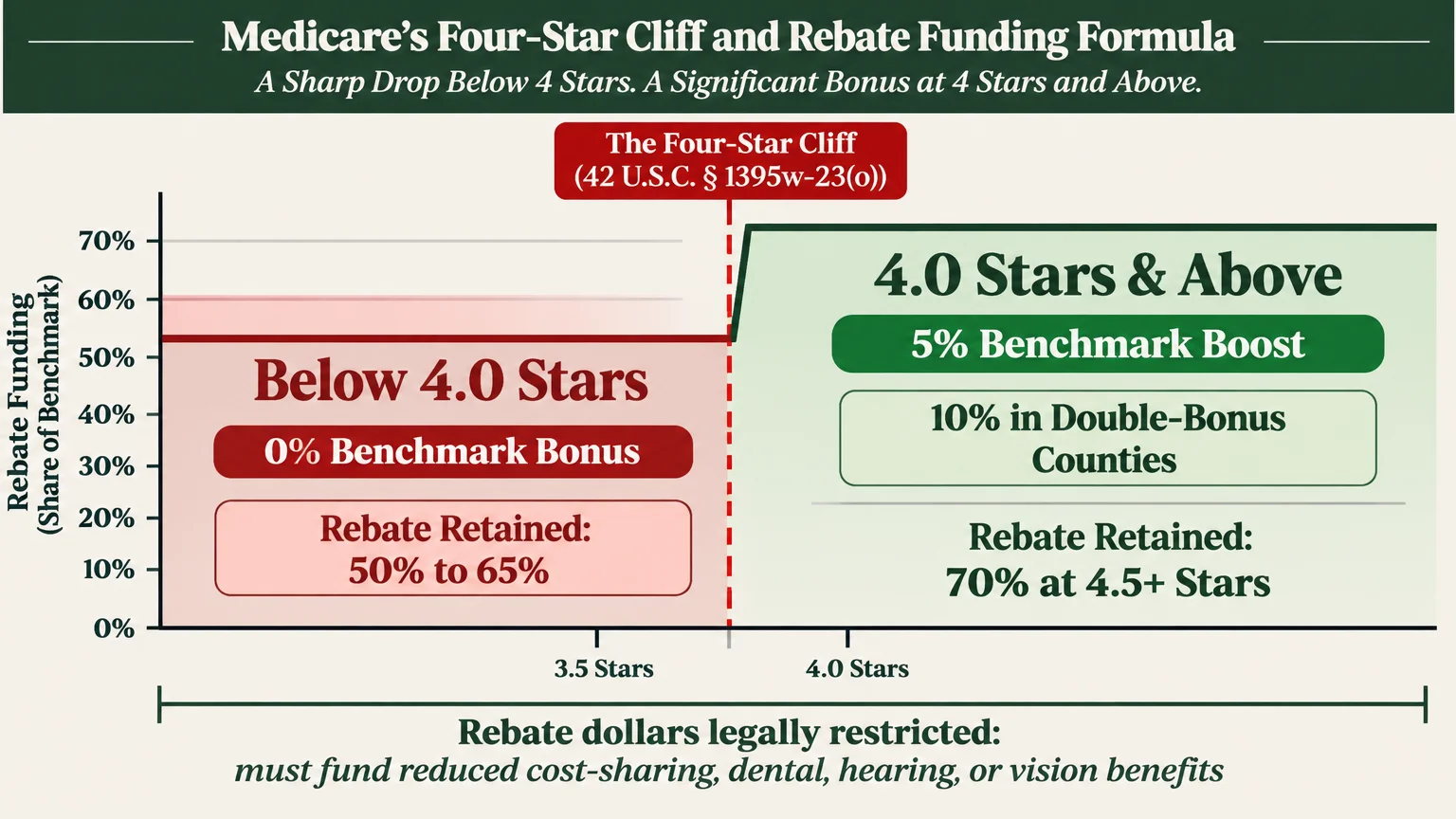
Star Ratings are far more than report cards for shoppers; they control billions of federal dollars. Under 42 U.S.C. § 1395w-23(o), contracts earning 4 stars or higher qualify for federal Quality Bonus Payments.
Specifically, reaching the 4-star threshold gives a contract a 5% increase to its county payment benchmark—the maximum amount Medicare pays a private insurer to cover basic benefits in your area. In qualifying double-bonus counties, that benchmark boost reaches 10%.
Dropping from 4.0 stars to 3.5 stars erases that entire benchmark bonus overnight. Because there is no partial bonus between 3.5 and 4.0 stars, industry experts often call the 4-star mark a bonus cliff.
Rebates and Your Extra Benefits
Star Ratings also dictate how much savings an insurer keeps when it operates efficiently. When an insurer bids below the county benchmark to deliver standard Medicare coverage, the government shares the remaining savings as a rebate.
According to federal law and KFF analysis, your plan’s Star Rating determines the exact percentage of savings the insurer keeps:
- 4.5 stars or higher: The insurer keeps 70% of the savings as a rebate.
- 3.5 to 4.49 stars: The insurer keeps 65% of the savings.
- Below 3.5 stars: The insurer keeps only 50% of the savings.
Here is why those percentages hit home for seniors. Federal law requires insurers to spend every rebate dollar directly on enrollees—never on corporate profits.
Insurers use rebate money to lower your Part A and Part B out-of-pocket deductibles and copays, reduce your monthly Part B or Part D premiums, or fund extra perks like dental, vision, and hearing coverage.
The Two-Year Payment Lag
Many beneficiaries assume a rating released in October 2026 changes their benefits in January 2027. Under 42 C.F.R. § 422.162, Star Ratings actually govern federal payments two calendar years later.
Therefore, the 2027 Star Ratings published on October 8, 2026, determine how much bonus and rebate money insurers receive for 2028. Insurers already locked in their 2027 plan designs and prices based on the previous year’s 2026 ratings.
Statutory Authority and APA Rulemaking
Two legal concepts sit at the heart of the UnitedHealth lawsuit. First, statutory authority asks whether Congress actually gave a federal agency permission to act under a written law.
UnitedHealth points to 42 U.S.C. § 1395w-23(o)(4)(A), which restricts the types of data CMS may use when grading plans. Second, the Administrative Procedure Act (APA) requires agencies to use notice-and-comment rulemaking before adopting binding new standards.
Notice-and-comment rulemaking forces regulators to publish proposed scoring changes publicly and consider feedback before enforcing them. Skipping that step can make an agency rule unlawful in federal court.

A Practical Guide to the UnitedHealth Lawsuit and Your Medicare Coverage
To understand how this legal clash could reshape your Medicare options, it helps to examine what UnitedHealth filed, how its contracts scored, and how federal courts have handled similar disputes.
Inside the November 2026 UnitedHealth Lawsuit
On November 19, 2026, UnitedHealth Group and its affiliates filed a federal lawsuit against CMS and the Department of Health and Human Services (HHS). The case, UnitedHealth Group, Inc. et al. v. CMS (Case No. 2:26-cv-00131-LGW-BWC), sits in the U.S. District Court for the Southern District of Georgia, Brunswick Division.
The case went to U.S. District Judge Lisa Godbey Wood, the same judge who ruled against CMS in a major May 2026 Star Ratings case. UnitedHealth challenges 26 quality and performance measures used in its 2027 ratings across 51 contracts.
Specifically, the dispute covers 45 rated contracts plus 6 newer contracts whose bonus eligibility relies on the parent organization’s weighted average rating under 42 C.F.R. § 422.166(d)(2)(vi). Fourteen of those 26 measures overlap with rules Judge Wood already struck down, while 12 face identical legal challenges.
Before going to court, UnitedHealth asked CMS on November 16, 2026, to recalculate its 2027 scores without the 26 disputed measures. CMS had not acted on that request when the complaint was filed, and the agency declined to comment afterward.
In its complaint, UnitedHealth claims excluding those 26 measures would raise the 2027 Star Ratings for all 45 rated contracts:
- 10 contracts would jump by 1.5 stars.
- 30 contracts would rise by 1 full star.
- 5 contracts would increase by 0.5 stars.
Even more importantly for the company’s bottom line, UnitedHealth states that 35 contracts covering roughly 2.9 million members scored below 4 stars—and all 35 would reach 4 stars or higher if recalculated. Reaching 4 stars restores federal Quality Bonus Payments for those members.
Although the complaint does not specify a dollar figure and the court has not yet ruled, financial analysts quickly sized up the stakes. On October 9, 2026, TD Cowen analysts estimated the lower 2027 ratings create a $13 per member per month headwind in 2028, totaling roughly $1.5 billion in lost revenue.
How UnitedHealthcare Medicare Plans Fared in 2027 Ratings
UnitedHealth is the largest Medicare Advantage insurer in the country, serving approximately 7.61 million members as of September 30, 2026—down from 8.44 million at the end of 2025. According to an American Medical Association study released November 17, 2026, the company holds roughly 30% of national Medicare Advantage enrollment.
When CMS released the 2027 Medicare Advantage Star Ratings on October 8, 2026, scores tightened across the entire industry. Out of 508 rated MA-PD contracts nationwide—down from 516 in 2026—only 188 contracts, or roughly 37%, earned 4 stars or higher.
By comparison, about 44% of MA-PD contracts scored 4 stars or higher in 2026. Five-star contracts also fell from 22 in 2026 to just 15 for 2027, bringing the national enrollment-weighted average down slightly from 4.01 to 3.99 stars.
Roughly 71% of all MA-PD enrollees remain in 4-star or higher contracts nationwide. For UnitedHealth, however, TD Cowen estimated that the share of its members enrolled in 4-star or higher contracts fell from 80% to 68%.
Several massive regional UnitedHealthcare contracts dropped below the 4-star bonus line in the October release:
- Missouri Contract H2802: Dropped from 4.0 to 3.5 stars, affecting roughly 393,487 members.
- Georgia Contract H1889: Fell from 4.0 to 3.5 stars, covering approximately 259,500 members.
- California Contract H0543: Dropped a full star from 4.0 to 3.0 stars, impacting roughly 243,320 members.
That California drop from 4.0 to 3.0 stars carries a double financial punch for 2028. Not only does the contract lose its 5% benchmark bonus, its rebate tier also shrinks from 65% down to 50%.
UnitedHealthcare did score high marks in specialized areas. The company holds 3 of the 15 contracts rated 5 stars for 2027, consisting primarily of institutional Special Needs Plans designed for nursing home residents.
The Clover Precedent, Industry Lawsuits, and Proposed Overhaul
UnitedHealth is hardly alone in challenging federal scoring methods. In fact, the insurer won a separate Star Ratings lawsuit it filed against CMS in September 2024 in the U.S. District Court for the Eastern District of Texas.
In that 2024 case over 2025 ratings, a single disputed CMS test-caller phone call knocked a UnitedHealthcare contract from 5 stars to 4 stars—costing an alleged $190 million in missed bonuses. U.S. District Judge Jeremy Kernodle ruled CMS’s phone call assessment was arbitrary and capricious and ordered a recalculation.
An even bigger turning point arrived in May 2026 in Clover Insurance Co. v. HHS. Judge Lisa Godbey Wood ruled that CMS unlawfully included 20 measures in Clover’s 2026 rating—holding that 10 measures exceeded statutory authority and 10 bypassed mandatory APA rulemaking.
Following that May ruling, CMS recalculated Clover’s PPO plan from 3.5 to 4.5 stars. In July 2026, CMS also issued voluntary upward-only recalculations to other insurers, raising scores for 9% of contracts and adding an estimated $600 million in 2027 federal bonus payments, according to KFF.
The Trump administration appealed the Clover ruling to the Eleventh Circuit on July 21, 2026, leaving the broader legal standard under review. Meanwhile, insurers filed a wave of copycat lawsuits targeting the 2027 scores.
As of late November 2026, at least 16 insurers—including UnitedHealth, CVS Health (Aetna), CareFirst BCBS, SCAN Health Plan, and Centene—have sued CMS over 2027 Star Ratings. Those 2027 suits put more than $4.2 billion in bonus money on the line, part of 19 post-Clover lawsuits totaling over $6 billion across two rating years.
These court battles reflect massive federal spending on Medicare Advantage bonuses. KFF reports Quality Bonus Payments reached at least $13.4 billion in 2026—up from $12.7 billion in 2025 and $3.0 billion in 2015—while MedPAC estimates total risk-adjusted spending is closer to $16 billion.
In 2026, those bonuses averaged $381 per enrollee in individual plans, $466 in employer or union plans, and $318 in Special Needs Plans. UnitedHealth collected $3.9 billion, or 29% of all federal bonus dollars, in 2026.
Just one day after UnitedHealth filed suit, CMS responded with a major policy announcement. On November 20, 2026, the agency released a proposed rule for the 2028 contract year that would overhaul the Star Ratings system entirely.
If finalized, CMS’s proposal would slash the measure count down to 15, eliminate the historical Reward Factor, and replace the 4-star bonus cliff with incremental quality payments. CMS estimates the changes—first affecting 2031 bonuses—would lower scores for 58% of MA-PD contracts, remove bonuses from 20%, and cut Medicare Advantage payments by $11.5 billion in 2031 and $107 billion through 2037.
What These Ratings Mean for Your Wallet and Enrollment Windows
Because 2027 Star Ratings control 2028 payments, your 2027 UnitedHealthcare copays, premiums, and dental or vision allowances will not shrink mid-year because of this lawsuit. However, if the lower ratings stand for 2028, UnitedHealth could face tighter margins in affected counties.
When insurers lose bonus and rebate dollars, they often adjust plan designs the following payment year to balance costs. For 2028, members in downgraded contracts like Missouri H2802, Georgia H1889, or California H0543 could see higher premiums, higher specialist copays, or scaled-back supplemental benefits.
Conversely, if UnitedHealth wins a recalculation—or if CMS settles—those 2.9 million affected members could keep stronger bonus-funded benefits heading into 2028. Either way, you do not have to wait passively for a judge’s ruling to evaluate your options.
You can use existing federal enrollment windows to review plans on Medicare Plan Finder right now:
- Annual Enrollment Period (October 15 – December 7, 2026): You can switch Medicare Advantage or Part D plans for 2027 coverage while viewing the contested 2027 Star Ratings online.
- Medicare Advantage Open Enrollment Period (January 1 – March 31, 2027): If you are already enrolled in a Medicare Advantage plan on January 1, you get one chance to switch to another Advantage plan or return to Original Medicare.
- 5-Star Special Enrollment Period (December 8 – November 30): Once per year, you may switch into an available 5-star plan in your county outside standard windows, though only 15 MA-PD contracts and zero standalone Part D plans hold 5 stars for 2027.
Medicare also protects beneficiaries stuck in consistently struggling plans. Contracts rated below 3 stars for three consecutive years carry a low-performing icon on Medicare Plan Finder—a flag hitting 4 MA-PD contracts covering roughly 12,000 members in 2027.
If your plan carries that low-performing icon, you receive a Special Enrollment Period to switch plans immediately. Federal rules at 42 C.F.R. § 422.510(a)(4)(xi) also authorize CMS to terminate contracts that stay below 3 stars for three years running.
Common Mistakes and How to Avoid Them
Headlines about billion-dollar healthcare lawsuits easily spark confusion during Medicare shopping season. Avoiding these five common mistakes keeps your coverage decisions grounded in facts rather than guesswork.
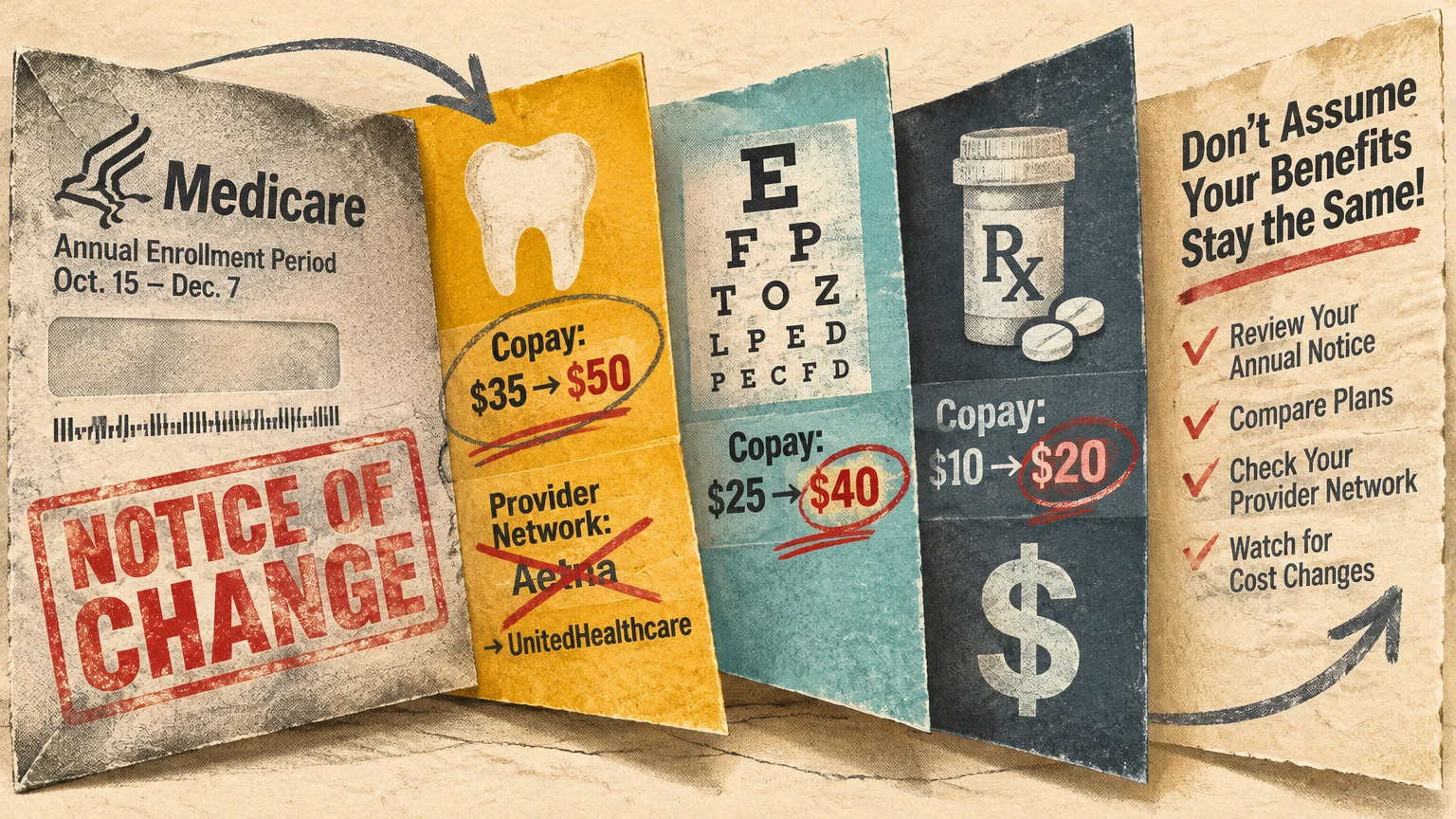
- Assuming your 2027 benefits will vanish right away: Remember the two-year payment lag. The October 2026 ratings affect 2028 federal funding, so always read your 2027 Annual Notice of Change (ANOC) separately to check your actual premiums and copays starting January 1, 2027.
- Shopping by insurer brand name instead of contract number: UnitedHealth operates dozens of separate contracts nationwide, and scores vary dramatically by region. Always check the exact contract ID—such as H2802 or H0543—on Medicare Plan Finder rather than assuming every UnitedHealthcare plan shares the same rating.
- Picking a plan based solely on Star Ratings: A 4.5-star or 5-star contract can still exclude your primary care doctor, specialist, or crucial prescriptions. Verify your doctors and medication tiers before switching for a higher star score.
- Waiting for the federal lawsuit to end before acting: Court battles and Eleventh Circuit appeals often stretch across months or years. Never let an open enrollment deadline pass while waiting for judges to settle a dispute between insurers and CMS.
- Returning to Original Medicare without checking Medigap rules: If you leave Medicare Advantage during the January–March Open Enrollment Period to return to Original Medicare, private Medigap insurers in most states can ask health questions and charge higher rates—or deny coverage—unless you qualify for state guaranteed-issue protections.

When to Consult a Professional
Major regulatory shifts and pending federal lawsuits create uncertainty, especially if you live on a fixed income or manage chronic conditions. While informational articles clarify the rules, qualified professionals can help you apply them to your personal situation.
Consider reaching out for tailored guidance in these situations:
- Licensed, independent Medicare insurance brokers: Consult an independent broker who represents multiple carriers if you want side-by-side comparisons of provider networks, drug formularies, and 2027 out-of-pocket maximums across different contract numbers.
- State Health Insurance Assistance Program (SHIP) counselors: Contact your local SHIP office for free, unbiased help reading Medicare Plan Finder, checking Special Enrollment Period eligibility, or reviewing Medigap rules in your state.
- Elder law attorneys or certified financial planners: Speak with a legal or financial advisor if you are coordinating Medicare choices with Medicaid eligibility, Special Needs Plans, or long-term care budgeting.
- Qualified legal counsel for individual benefit disputes: You cannot join UnitedHealth’s lawsuit against CMS, which only challenges federal contract scoring. However, if your plan wrongfully denies a specific medical procedure or prior authorization, an attorney or patient advocate can explain your formal Medicare appeal rights.
For official information, consult government resources like USA.gov, the Consumer Financial Protection Bureau (CFPB), and the Federal Trade Commission (FTC).
For tax-related topics, refer to the IRS. For information on Social Security, visit the Social Security Administration.
Frequently Asked Questions (FAQs)
Will my UnitedHealthcare Medicare Advantage plan lose benefits in 2027 because of this lawsuit?
No, the 2027 Star Ratings released in October 2026 do not alter your 2027 plan benefits. Under federal rules, 2027 ratings set Quality Bonus Payments and rebates for the 2028 plan year—meaning any rating-driven benefit pressure would appear in 2028.
How do I check if my specific UnitedHealthcare plan lost stars?
Log into Medicare Plan Finder or review the front cover of your plan’s Evidence of Coverage to locate your contract number, which starts with an H or R followed by four digits. Then check your contract’s 2027 Star Rating directly on Medicare Plan Finder.
Can I switch plans right now if my contract fell below 4 stars?
You can switch during the Annual Enrollment Period from October 15 through December 7, 2026, or during the Medicare Advantage Open Enrollment Period from January 1 through March 31, 2027. Dropping from 4.0 to 3.5 stars alone does not trigger a Special Enrollment Period.
What happens if UnitedHealth wins—or loses—the lawsuit?
If Judge Wood rules for UnitedHealth and orders a recalculation, affected contracts could rise to 4 stars or higher, restoring federal bonus funds for 2028. If CMS wins or prevails on appeal, UnitedHealth will face lower 2028 federal benchmarks and rebates in downgraded contracts.
Does CMS’s November 20, 2026 proposed overhaul affect my coverage today?
No, that announcement is only a proposed rule that must still go through public comment and finalization. Even if CMS finalizes the shift to 15 quality measures, the payment changes would not begin affecting federal bonus calculations until 2031.
Disclaimer: The information provided on this website does not, and is not intended to, constitute legal advice; instead, all information, content, and materials available on this site are for general informational purposes only. Information on this website may not constitute the most up-to-date legal or other information. Readers of this website should contact their attorney to obtain advice with respect to any particular legal matter.