Your smartphone gives you the instant ability to record conversations, making it incredibly easy to capture moments that feel important to your life. But capturing audio or video without fully understanding privacy laws can quickly lead to severe legal consequences, including heavy fines or criminal charges. Many people assume they have the absolute right to record anything they see or hear, only to discover later that they violated someone else’s rights. Understanding the boundaries of legal recording empowers you to protect yourself and avoid devastating legal mistakes. By learning the critical difference between public spaces and private conversations, you can navigate everyday situations confidently while respecting the legal boundaries established by both state and federal regulations.
Key Concepts and Terminology Explained
Before you tap the record button on your phone or install a security camera on your property, you need to understand the foundational rules that govern audio and video capture. State and federal recording laws balance your desire to document an event with the fundamental rights of others to remain private. When you ignore these concepts, you expose yourself to severe civil and criminal liabilities.
The Reasonable Expectation of Privacy
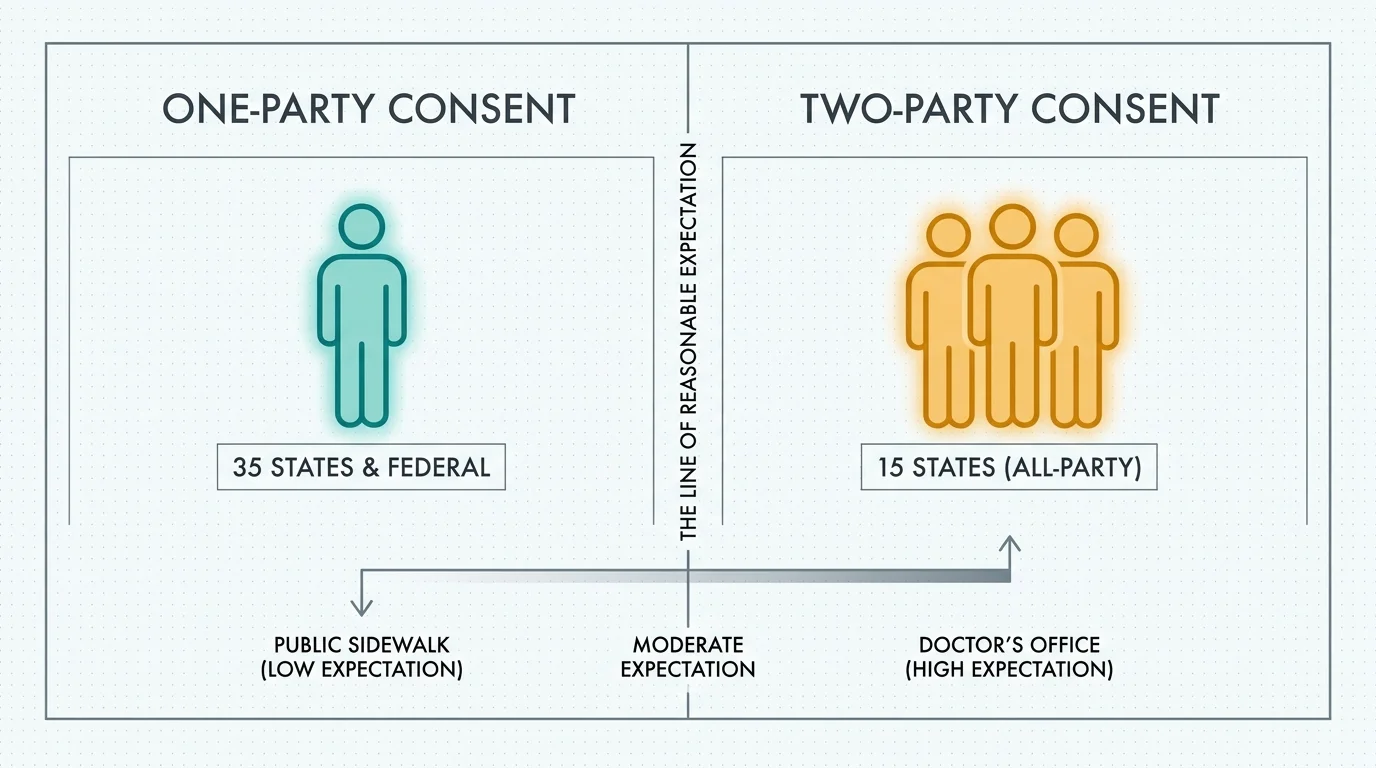
The bedrock of most privacy laws involves a simple but powerful legal concept known as the reasonable expectation of privacy. This principle asks whether an average person would assume their words or actions are private in a given setting. If you stand on a busy sidewalk shouting at a friend, you have no reasonable expectation of privacy. Anyone walking by can hear you, and therefore, someone recording you in that public space generally acts within their rights. However, if you sit in a doctor’s examination room or close the door to your personal office to make a phone call, you rightfully expect those conversations to remain confidential. Recording someone in a space where they expect privacy constitutes a severe violation of the law.
One-Party Consent Versus Two-Party Consent
In the United States, recording laws generally fall into two distinct categories regarding audio recording: one-party consent and two-party consent. Federal law operates under one-party consent. This means you can legally record a conversation as long as you are actively participating in it. You provide the single required layer of consent. About thirty-five states follow this federal standard. If you live in a one-party consent state, you do not need to inform the other person that you are recording a conversation you are actively involved in.
Conversely, roughly fifteen states operate under two-party consent—frequently called all-party consent. In these states, which include California, Florida, Pennsylvania, and Massachusetts, every single person involved in a conversation must agree to be recorded. If you participate in a phone call with three other people in a two-party consent state, all four of you must consent. If you secretly record the call without informing them, you commit a crime, often categorized under state wiretapping statutes.
Audio Versus Video Recording
The law treats audio and video very differently. While video recording in public spaces usually receives strong legal protection under the First Amendment, audio recording faces much stricter scrutiny. Strict wiretapping laws primarily target the interception of sound. You might legally film a quiet interaction between two people across a public park, but if you use a parabolic microphone to capture their whispered conversation, you cross the line into illegal eavesdropping. Audio requires a much higher standard of consent than silent video.